Chancellor Friedrich Merz has sent mixed signals on whether Germany will contribute troops to a European force in Ukraine as part of post-ceasefire security guarantees.
A day after Berlin talks with European leaders and US negotiators, Mr Merz told German television he could envision peace-agreement rules that would permit German troops to “retaliate against corresponding Russian incursions and attacks”.
“We would secure a demilitarised zone between the warring parties and, to be very specific, we would also act against corresponding Russian incursions and attacks,” he said. “But we’re not there yet.”
On Monday in Berlin, leaders of 11 European countries including Germany, France, and the UK said they could imagine providing troops to “assist in the regeneration of Ukraine’s forces, in securing Ukraine’s skies and in supporting safer seas, including through operating inside Ukraine”.
READ MORE


After previous resistance to providing such security guarantees, US negotiators backed this proposal in Berlin – something the chancellor described as a “remarkable new position for the United States”.
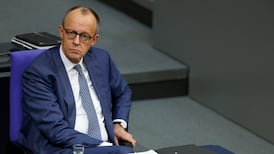
During parliamentary questions on Tuesday, Mr Merz was less clear about Germany’s contribution to any security guarantees for Ukraine. He said he was primarily concerned with ending the war in Ukraine. And would he be prepared to send troops to Ukraine, a member of the Bundestag MP wanted to know, yes or no?
“There are questions in this world that are not as easy as you might think to answer and this question is one of them,” said Mr Merz to a query from the pro-Russian far-right Alternative for Germany (AfD). “We will talk about security guarantees for Ukraine after a ceasefire that must be agreed with Russia.“
In a lively Bundestag exchange, AfD co-leader Tino Chrupalla accused the chancellor of “ramping up the escalation spiral in Europe” and “talking of security for Ukraine when you mean rearmament”.
“We are glad to have left the east-west conflict behind us,” added Mr Chrupalla, “but with your multilateral troop idea, you are summoning it up once more.”
The Monday agreement – and Mr Merz’s remarks on German troops – have caused a certain amount of confusion in Berlin’s coalition government. Defence minister Boris Pistorius admitted he was “not directly involved” in the troop proposals.
The centre-left Social Democratic Party (SPD) minister said much had yet to be discussed.
Other SPD politicians said they were “ruling nothing out”, but also nothing in.
Mr Merz was challenged by German journalists about how western troops in Ukraine had, until now, been a taboo for Russian president Vladimir Putin.
“Put has said nyet to a lot of things,” replied Mr Merz with reference to the Russian word for no. “At some point, he will have to say yes if it is about ending the war.”