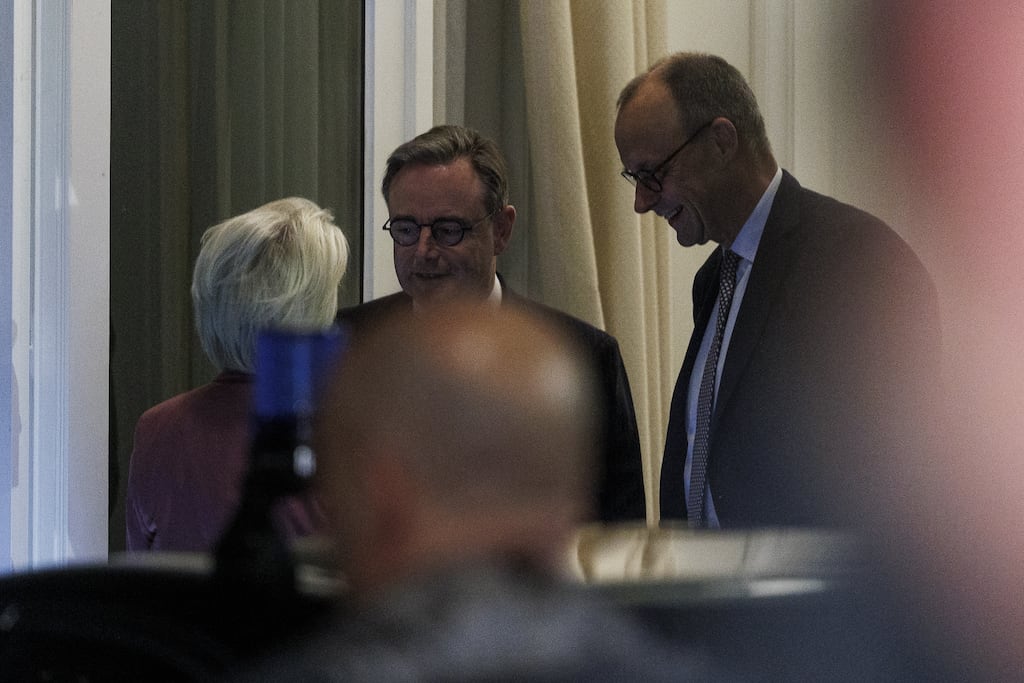

A euro for the thoughts of Belgium’s prime minister Bart De Wever. At the moment his opinion could be worth about €90 billion to Ukraine.
The hard-right Flemish nationalist is withholding his support for a plan to use a large pile of sanctioned Russian state cash, frozen inside financial institutions in Europe, to finance a lifeline loan to Ukraine.
The leaders of the European Union’s 27 states will walk into a room on Thursday morning for a Brussels summit that may go on for as long as it takes to come out holding a deal.
Without a significant package of financial aid from Europe, Ukraine is expected to start running out of money in the spring. Nobody is banking on Vladimir Putin compromising for peace.
READ MORE


Nearly all of the frozen Russian assets are in Euroclear, a Belgian institution that minds government bonds. So everyone’s eyes are on De Wever, who would need to lift his opposition to using sanctioned cash to back up a loan, to finance Ukraine’s efforts on the battlefield for the next two years.
The money would be paid back to Russia if Moscow ever agrees to compensate Ukraine for the destruction caused by its invasion and the four years of war that followed.
Belgium is afraid the plan will leave it exposed to all kinds of possible retaliation from Russia and damage its reputation as a safe place to put your money.
A huge amount of technical and legal work has gone into addressing Belgium’s concerns.
Those who know much more than I do insist significant changes have been made. EU states would jointly take over nearly all foreseeable risks, so that Belgium is not left carrying the can from any fallout on its own. This has not shifted De Wever.
Belgium wants everyone to go farther and is seeking a blanket guarantee of unlimited value to cover all possible risks.
The loan only needs a big majority of EU leaders behind it, rather than unanimous approval. That gets around Hungary’s Kremlin-friendly leader Viktor Orban, who will block any aid to Ukraine.
Politically though, it would be almost impossible for the rest of the leaders to move ahead without Belgium’s tacit approval.
To throw this into a bit of context, imagine France, Germany and the rest of the EU had decided to cut a different type of Brexit deal with the UK, over the objections of Ireland.
Taking decisions by consensus has traditionally avoided situations where the genuine and sensitive national interests of one member state can be trampled by the rest.
“I think all the leaders are very much aware of the disproportionate stakes of Belgium in a reparations loan solution. That is being taken into account,” said one senior EU official involved in negotiations.
In a speech on the eve of the summit, European Commission president Ursula von der Leyen said Europe was facing a world of wars and predators. “We Europeans must defend ourselves and we must depend on ourselves,” she said.
A lot has been bet on the Russian assets loan.
Some clarity on the figures, because there is a fair amount of euros and zeros flying about. In total there is €210 billion worth of Russian state assets frozen inside the EU by the bloc’s sanctions targeting Moscow.
The vast majority of that, about €185 billion, is held in the Belgian securities depository Euroclear. A further €25 billion is spread across banks in several other EU states.
Governments will have to voluntarily provide financial guarantees to backstop that total amount, to cough up the money in the unlikely scenario where early repayment to Russia is triggered.
It is clear that if Belgium is going to come around to back the plan, it will only happen after hours – or maybe days – of negotiations between leaders.
Other options to shore up Ukraine’s finances are no easier.
Plan B envisages the EU borrowing money on the financial markets, which member states would jointly pay back over time, to provide a loan to Kyiv.
Common borrowing would need the sign-off of all 27 leaders. Orban and Slovakia’s populist prime minister Robert Fico would almost certainly refuse. Officials say the idea for a joint EU loan has been taken off the table and put back up on the shelf.
De Wever is expected to ask leaders to consider using emergency powers to overrule Orban’s veto to back the common EU loan option.
A lot of national governments’ budgets are already pretty stretched. Maybe leaders (minus Orban and Fico) could rustle up €10 billion or €20 billion, by borrowing money individually to hand to Ukraine. That would be far short of what it needs and probably just buy a bit of time.
The meeting of leaders, known as the European Council, is where the big political decisions are supposed to be taken.
Emerging from the summit empty-handed would do grave damage to the EU’s standing in the shifting world order, where Brussels is increasingly fighting for relevance with Washington, Beijing and Moscow. No one would be more disappointed than Ukraine.