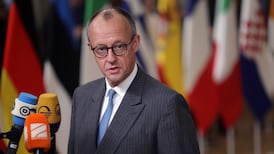
Friedrich Merz ramped up German expectations of this week’s EU summit as the most important since he became chancellor last May.
Days after Germany secured a deal to extend the life of its beloved diesel and petrol cars, Merz was confident Berlin would prevail again in Brussels on the Mercosur trade deal and a plan to finance Ukraine’s war effort with seized Russian assets banked in Belgium.
The latter idea was one Merz himself floated last September in the Financial Times. But at 3am in Brussels on Friday morning, his idea dead, Merz insisted the alternative agreement was a “great success”. Ukraine still would get its money, Merz said, by “Europe making an advance payment” of €90 billion.
The first reviews in Germany – on this multibillion advance and the chancellor’s overall performance – were not kind.
READ MORE


The influential, conservative Frankfurter Allgemeine described the outcome as a “defeat for Merz”.
“A black day for Merz,” agreed Die Welt, another conservative daily. “He represents a certain leadership entitlement to which he himself is not able to measure up.”
On national radio, political analyst Ursula Weidenfeld suggested it was something that at least 24 of 27 leaders were able to agree. “But it’s hardly a big success,” she added, “if the first congratulations come from Moscow.”
News magazine Stern described the chastening result as a “first Brussels lesson for Merz”.
The 70-year-old began his career as an MEP in the European Parliament in 1989 but held no government role in the subsequent 36 years until he entered the chancellery in May. Some seasoned German summit watchers think Merz’s lack of political experience is telling – and worrying.
After the last summit in October, Merz surprised many by suggesting a Mercosur deal had been reached: “It’s done, it’s through.”
It was neither done nor through. That irritated further EU counterparts – in particular smaller countries – annoyed by how Merz piled pressure on Belgium to change its mind on Russian assets.
“He didn’t take the Belgian resistance seriously. He just thought they would fold,” said a former Merkel official, insisting the former chancellor would not have made such a misstep.
[ Ukraine deal: EU leaders agree €90bn loan after frozen Russian assets plan failsOpens in new window ]
Some in Berlin argue it was unfair to blame Merz alone for his failure and point the finger at another German: European Commission president Ursula von der Leyen.
From the start the Merkel protege pushed the asset seizure proposition – until it was off the table. Given that failure, and the Mercosur delay, Die Welt wondered on Friday: “Who is advising Ursula von der Leyen?”
Influential diplomat Wolfgang Ischinger said that the EU had achieved its goal, but at a considerable cost to the EU’s credibility as a reliable, united international player.
As CDU officials struggled to remain diplomatic on Friday, the far-right Alternative for Germany (AfD), founded in opposition to euro crisis bailouts, pounced on the deal as more of the same.
“Ukraine gets the money, France and Italy get the common debt they always wanted,” tweeted Beatrix von Storch, an AfD parliamentarian in Berlin, “and of course the Germans have to pay. It is a fiasco, a tragedy.”
Even mainstream political analysts see, in the fallout from the Ukraine deal, echoes of Germany’s euro crisis debate.
Back then, heated debate about the cost to the German taxpayer of bailing-out Greece – in the end, nothing – drowned out talk of the wider value of holding the euro zone together.
“It’s irritating enough that Merz didn’t notice the other EU countries weren’t behind him,” said Gero Neugebauer, a Berlin-based political scientist. “But the genie released by Merkel and Schäuble over aid for Greece – that we Germans have to pay for everything – cannot be put back in the bottle now.”