
During that first summer in Berlin, my strangest encounter took place in the shadow of the Kaiser Wilhelm memorial church.
The ruined church tower in western Berlin is quite an eyeful, and the elderly woman standing before it was quite an earful.
In the hot Saturday sun, wearing a round cloth cap, she shouted at passersby: “Ficken ist frieden. Wollt ihr frieden?” Which translates as: “F**king is peace. Do you want peace?”
I wasn’t brave enough, nor was my German good enough, to ask the woman who she was or how she had arrived at her conclusion.
READ MORE


Answers have now come, a quarter century later, in a new exhibition dedicated to the Ficken ist frieden lady.
Her name was Helga Goetz, she was born in 1922, married aged 20 and had seven children in quick succession.
Eventually Helge found a new home in West Berlin, then a walled-in, anything goes alternative paradise
But her life changed forever in 1968 when, marking her silver wedding anniversary with her husband in Sicily, she met Giovanni.
After a memorable meeting – “he started stroking me along the back” – Giovanni asked her husband if he could “be alone” with Helge.
The husband agreed, Giovanni took her to a hotel room and, according to Helge later, her “entire world to date collapsed”.
“I was packed into the marriage crate at 20 with a distinguished, faithful husband,” she said later, “But for the first time, I realised what the competition had to offer.”
Back in Hamburg, unsure how to break out of what she called her “prison of laws and habit”, her husband encouraged her to place classified advertisements in local newspapers: “Female being, intellectually diverse, seeks ...”
That lead to a 1973 television show appearance, where Helge urged goggle-eyed women to shrug off 6,000 years of patriarchy and embrace the sexual maturity she felt comes to women in the second half of their lives.
The two-hour show caused a national scandal and a Bild front page: “Mother of the Nation or Germany’s Super-sow?”
According to Helge, it also saw her husband’s bank pension him off early for “not having his wife under control”.
A year later, in 1974, Helge left the family home for good – the youngest of her seven children was by then 14. Eventually she found a new home in West Berlin, then a walled-in, anything goes alternative paradise. There she developed a one-woman religion that merged – and subverted – the city’s previously separate preoccupations of pacifism, sexual liberty and spirituality.
In her apartment she founded what she called her “Geni (t) ale University”, holding weekly “fairy tale sessions” where guests could listen to her poetry and theories.
Yet Helge was too extreme even for the West Berliners. Local radical feminists denounced Goetze, by now in her 60s, as “that shameless auld one”.
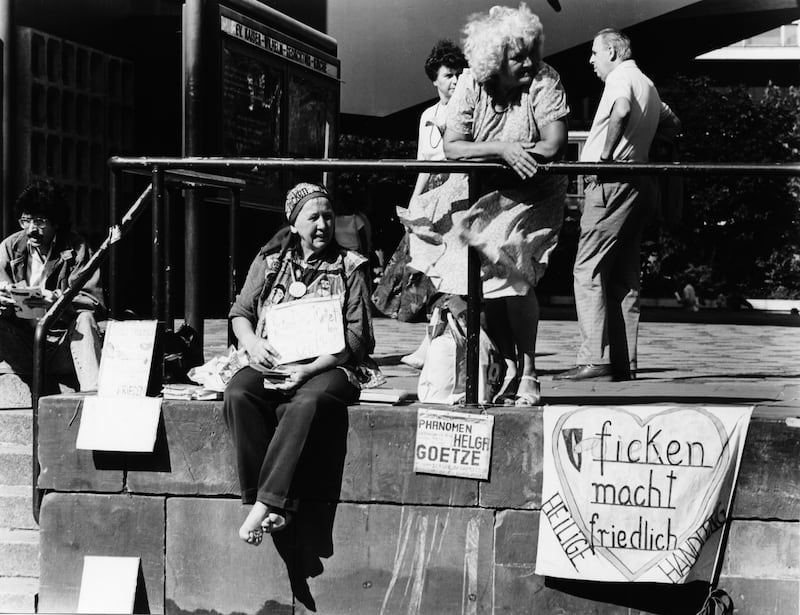
Meanwhile the city’s communards and their polyamory, Helge thought, reflected a male obsession with the quantity of sexual encounters.
She favoured quality over quantity, viewing sex as a “mode of communication, contact and peace”.
By the time she died in 2008 Helge had produced 30,000 pages of observations and sketches about female sexuality – and the effect of her proselytising on the city around her.
The “passing police nod in a friendly way,” she wrote after one vigil, while the passersby “stream towards me, freeze up, want to be annoyed, are fascinated, start to curse, go, stand still, come back – and are changed”.
At a recent gathering in the Berlin museum, Helge’s son Ulrich, now a retired accountant, said that he still struggled with his mother’s sexual energy.
“I don’t want to judge but her whole indecency thing wasn’t my thing,” he told the group. “And all that use of the word ‘f*cking’ ...”
It’s hard to know what Helge would have made of the Berlin exhibition. On the one hand it is a belated celebration of her as a provocative pioneer. At the same time it shoehorns her posthumously into a dry queer theory framework.
The curators could simply celebrate the colourful abundance of Helge’s erotic embroidery, a lavish display of primitive figures with outsize genitalia. Instead the works, created during her street vigils, are noted for “diverting handicrafts from the private sphere to the urban space”.
This, we learn, “parallels today’s activist movements, which reclaim textile practices and use them for feminist spatial appropriation”. You could say that. Or you could simply say that Helge, more about practice than theory, felt the world would be a better place if everyone, particularly women, had more and better orgasms.
Like a real-life sister of Hedda Gabler and Shirley Valentine, Helge Goetze was a one-woman, multimedia emancipation movement. After breaking out of society’s strictures, it’s clear she loved every minute of her liberated life: “I walk like a queen through the hustle and bustle of the Kurfürstendamm, waving a flag over my shoulder.”