A rail crash has killed at least 40 people and injured more than 150 in southern Spain after two packed high-speed trains collided in one of the worst accidents in the country in more than a decade.
The incident on Sunday evening near Córdoba occurred when the tail-end of a train travelling from Málaga to Madrid derailed and smashed sideways into an oncoming train on a parallel track.
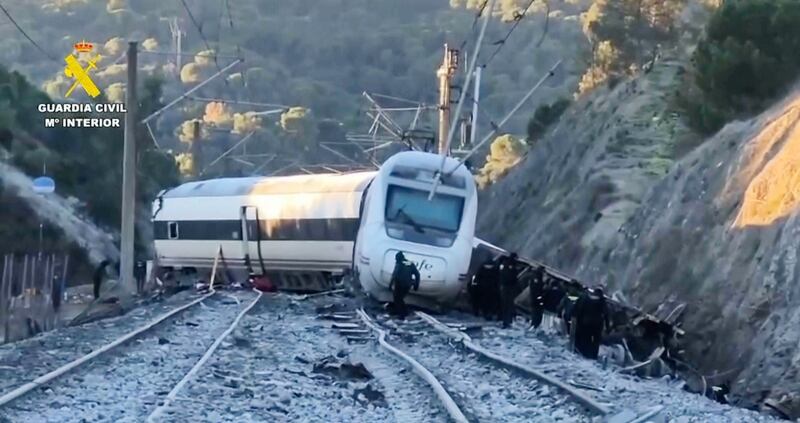
Several carriages of the Madrid-bound train derailed at about 7.45pm local time and the force of their impact on the second train pushed some of its carriages down a 4m-slope.
“The impact was so incredibly violent that we have found bodies hundreds of metres away,” said Juan Manuel Moreno, president of the regional government in Andalucía, where the crash happened.
READ MORE


As videos from the scene on Monday showed mangled carriages lying on their sides, the authorities were asking family members of passengers to provide DNA samples to help identify victims.
Experts investigating the cause of the derailment found a broken joint on the rails, according to a source briefed on initial investigations into the disaster, Reuters has reported.
Technicians on site analysing the rails identified some wear on the joint between sections of the rail, known as a fishplate, which they said showed the fault had been there for some time, the source said.
They found that the faulty joint created a gap between the rail sections that widened as trains continued to travel on the track.
The source, who declined to be identified due to the sensitivity of the issue, said the technicians believe the faulty joint is key to identifying the precise cause of the incident.
At least 152 people were injured in the crash, which happened 360km south of Madrid, said state broadcaster RTVE on Monday morning.
The death toll was the worst in a Spanish rail crash since 2013, when 80 people died after a high-speed train derailed on a curve near Santiago de Compostela in Galicia.
Óscar Puente, Spain’s transport minister, called the crash “truly strange” as it happened on a straight stretch of railway. He added that the train that initially jumped the track, which was owned by Italian operator Iryo, was less than four years old.
Álvaro Fernández Heredia, president of state rail operator Renfe, said there was a 20-second gap between the first derailment and the collision between the trains, an interval too short for an automatic braking system to be activated.
Both trains were travelling well under a speed limit of 250km/h, he said. Mr Fernández ruled out “human error” as the cause of the crash, saying it must instead relate to Iryo’s train or the railway infrastructure.
Iryo said it “deeply regrets” the crash and that its train had derailed “for reasons that are still unknown”. It added that it “is fully available to the commission in charge of investigating the accident and will co-operate fully, providing any information required to clarify the facts”.
[ ‘Extremely strange’: Experts baffled by deadly high-speed train crash in SpainOpens in new window ]
Pedro Sánchez, Spain’s prime minister, declared three days of national mourning for victims of the crash and cancelled his planned trip to the World Economic Forum in Davos this week.
Salvador Jimenez, a journalist at RTVE who was on one of the trains, described the impact, saying: “There was a moment when it felt like an earthquake.”
The trains were packed with people returning home from weekend trips, with the Madrid-bound train, run by Iryo, carrying about 300 passengers. There were 184 people on the second train, run by state rail operator Renfe, which was travelling from Madrid to Huelva.
Spain takes pride in the quality of its high-speed rail network, which is one of the most extensive in the EU. – Copyright The Financial Times Limited 2026/Reuters


