

Berlin is used to being Germany’s laughing stock. The laughter was particularly loud when its new airport opened in 2020, eight years and 1,066 per cent over budget.
Loud sniggers accompanied news that the costs of renovating the monumental Pergamon Museum, closed until 2037, have already spiralled 500 per cent above original estimates.
The rest of the city is a graveyard for urban ambition. Smaller building sites often have no visible building for years. Underground station renovations take longer than the original construction.
There are ongoing battles with rubbish, drugs and weeds. And let’s not forget the January 3rd power outage, after an attack on electricity lines by far-left activists, that left 45,000 households and 8,000 firms and care homes in the cold and dark for almost a week.
READ MORE


All of the above shortcomings will be familiar to regular readers of The Irish Times. But this week we have a new entry in our occasional series on “the myth of German efficiency”.
After a fortnight of snow, sleet and sub-zero temperatures, the German capital appears to have capitulated to winter rather than sideline its most dangerous urban side effect: hazardous, icy pavements.
In previous years, as in most German cities, Berlin has made a decent effort to clear main footpaths with specialised cleaning machines, grit and salt.
This year, however, city hospitals are heaving with injured Berliners.
“We are trying to keep our head above water, we’ve had an extreme number of falls, breaks and fractures,” Dr Paul Waschk, of Berlin’s Elisabeth Clinic, told local broadcaster RBB.
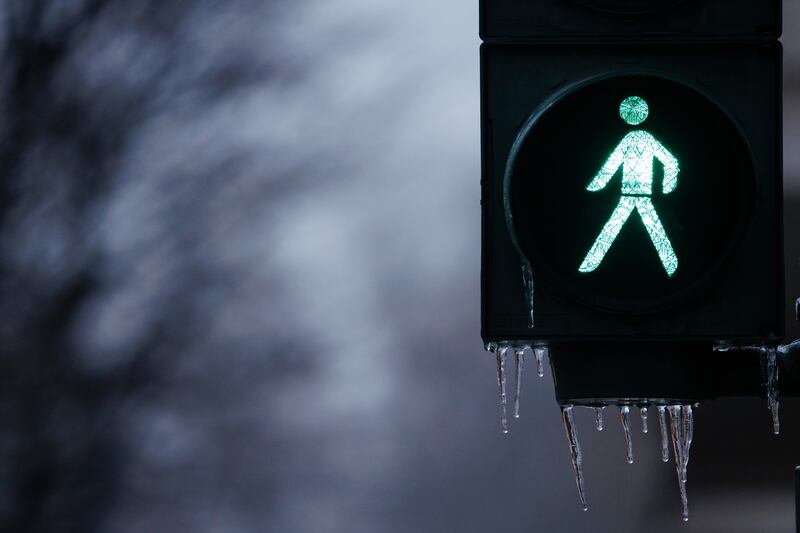
Many put the blame on a citywide ban on Tausalz or de-icing salt, due to environmental concerns for trees and ground water. Berlin has banned the use of the substance and ordered local authorities to use grit instead. But if they are using grit, they are doing so in homeopathic doses, while ice-clearing machines are nowhere in sight.
Mario, my DHL delivery man, had hiking boots on last Friday: “You always have to lower your expectations in Berlin but things are even worse this year. I’m walking around out there like a penguin.”
The pavement problem prompted Berlin’s governing mayor Kai Wegner to make an urgent appeal on X to the Berlin city state parliament: “We are experiencing extreme weather conditions. I appeal to the [state] parliament to make an exception to allow the use of de-icing salt.”
His appeal attracted over one million views – and a deluge of derision.
“You can’t manage even this,” fumed one Berliner, replying on X. “Berlin will discuss this for a few weeks, people will break their bones (my 81-year-old father too) and perhaps they will have an agreement by Easter.”
Thankfully, Berlin has managed to move earlier. On Friday Wegner’s city government finally activated its pre-existing executive powers to override the salt ban – given the extreme weather situation.
Even if the ice melts, many Berliners remain frosty towards Wegner and his talent for indecision.
[ Winter weather causes travel chaos across much of EuropeOpens in new window ]
Particularly the 100,000 people affected by the early January blackout. Many slept on camp beds in school sports halls and verbally attacked him on his belated appearance, three days into the crisis.
Asked why he had not shown up on day one, Wegner said he had spent the entire first day “locked into” his home office.
“I was neither bored yesterday nor did I put my feet up,” he said angrily. “I was on the phone the entire day and tried to co-ordinate and inform myself.”
“This helped people more,” he said, than PR visits to emergency centres.
A day later, he had to backtrack and admit he had unlocked his office to squeeze in an hour-long game of tennis.
In a bad sign, his crisis management skills have attracted mockery even from fellow members of his centre-right Christian Democratic (CDU) party.
“No, this is no surprising weather crisis,” said Armin Laschet, a prominent Bundestag MP, “it’s called winter”.
[ Berlin power outages after left-wing anarchist attack on power cablesOpens in new window ]
Laschet knows personally how quickly poor judgment in a crisis can shatter political ambition. During the 2021 federal election campaign, he was caught on camera laughing and joking during a visit to a flood-hit region, sinking his campaign as CDU chancellor hopeful.
Many in the capital think Wegner’s days as mayor are numbered given Berliners elect a new state parliament – and a mayor – in September. The Berlin CDU is down nine points on this time last year – and six points on its last election result – to 22 per cent. Polls suggest a three-way centre-left coalition is already possible for the German capital.
Wegner’s recent series of slip-ups mean that even thick-skinned Berliners have reached their laughing-stock limit.
“On holidays I don’t admit I come from Berlin any more,” wrote X user Freddie in response to the Wegner posting. “It’s just too embarrassing.”


