
German chancellor Friedrich Merz has urged Europe and the United States to “revive and repair” the transatlantic relationship while conceding the postwar order is “currently being destroyed” for a new era dominated by large powers.
The German leader swung from conciliatory to challenging in his Munich Security Conference opening address on Friday, warning the US that its leadership role in the world was no longer unchallenged “and perhaps it has even been gambled away”.
“Even the US will come up against the limits of its powers if it decides to go it alone,” he said.
Switching to conciliatory, the German leader insisted European alliance members were reversing decades of defence underinvestment and “self-inflicted dependency” on the US to build a “self-supporting European pillar” on security and defence.
READ MORE


This new self-confidence and strength, said Merz back in challenging mode, had revealed itself for the first time in last month’s united front against Donald Trump’s annexation threats towards Greenland.
He said Danish prime minister Mette Frederiksen, sitting in the Munich audience, “knows that she can depend on European solidarity with no ifs or buts”.
[ Breaking up is hard to do: Europe confronts end of the old orderOpens in new window ]
In a final warning against the temptations of authoritarianism, Merz warned: “We Germans know that a world in which only power counts would be a dark place. Our country followed this path in the 20th century to the bitter – and evil – end.”
A year ago, US vice-president JD Vance dropped a bombshell at the Munich Security Conference by accusing European leaders of undermining democracy by muzzling critics of liberal migration policy.
The Vance aftershock was still palpable on Friday as US and European Union politicians’ remarks swung from couples counselling to divorce talks to change management.
European leaders lined up to back Merz, with Finnish president Alexander Stubb calling for new “values-based realism” that acknowledged that “you cannot solve issues of trade, conflict, climate or technology just with like-minded countries”.
US delegates were cooler on the Merz address, dismissed by Republican senator Thom Tillis of North Carolina as “hyperbolic”. American citizens, Tillis said in a testy panel on tariffs, “understand that our future, our past and our present [are] rooted in western, rule-of-law democracies”.

After his speech, Merz held a 30-minute meeting with US secretary of state Marco Rubio, who will address the conference on Saturday morning followed by his Chinese counterpart, Wang Yi.
As Russia’s war on Ukraine nears its fourth anniversary, Ukrainian president Volodymyr Zelenskiy met 11 European leaders in Munich and opened a German-Ukrainian drone plant with “no real upper capacity limits”.
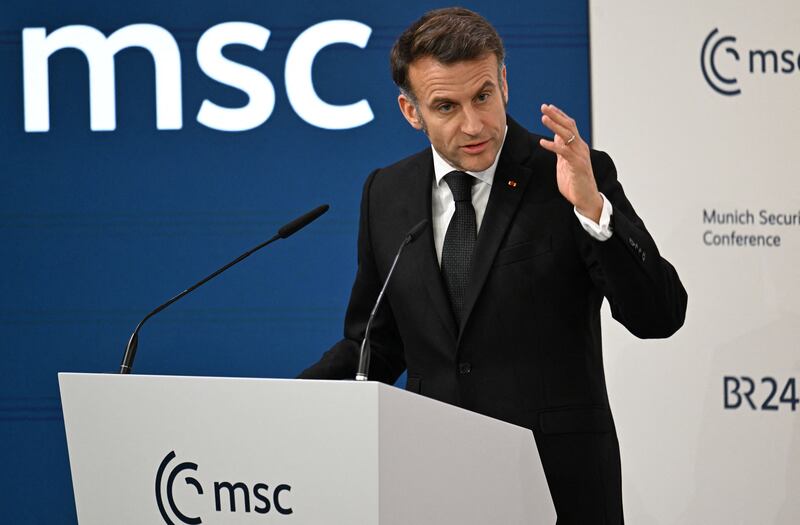
French president Emmanuel Macron adopted a tone of can-do realism, promising that Europe would show “strength and tenacity” to support Ukraine “to the last minute” and build its own security architecture.
“This Europe will be a good ally and partner for the US,” he said, “because it will be a partner taking its fair share of the burden and being respected.”
On Friday Democrat politicians fanned out across Munich, insisting that another America is still open for business.
A day after Trump revoked a foundation stone of modern climate policy, California governor Gavin Newsom accused the president of “doubling down on stupid”.
“I think this is a moral moment across the board, not just on climate but democracy: call this guy out and stop with the BS diplomacy,” he said.
In a nod to the fateful 1938 Munich meeting between British prime minister Neville Chamberlain and Nazi dictator Adolf Hitler, Newsom added: “We are all becoming Chamberlains in this space. Leaders have to stand up.”
At a separate panel with its own historical echoes, Democrat congresswoman Alexandria Ocasio-Cortez urged world leaders to deliver “working-class-centred politics if we are going to succeed and stave off the scourge of authoritarianism”.


