
The Kremlin has launched a disinformation campaign aimed at helping Hungarian prime minister Viktor Orban get re-elected next month, according to people familiar with the matter.
Vladimir Putin’s administration has endorsed a plan by the Social Design Agency, a Kremlin-linked media consultancy under western sanctions, to bolster Orban’s Fidesz party by flooding social media with messages designed in Russia and posted by influential Hungarians.
The campaign frames Orban as the only candidate who can keep Hungary sovereign and treat world leaders as equals, according to a proposal written by the agency for the Kremlin late last year.
It intends to contrast Orban, a “strong leader with global friends”, with his main rival Péter Magyar, a “Brussels puppet with no outside support”, the proposal says.
READ MORE


Magyar has emerged as the most serious challenger to the decades-long rule of Kremlin ally and Brussels antagonist Orban in the April 12th election.
The plan suggests “information attacks” against Magyar, whose Tisza Party is ahead in opinion polls. It intends to paint Tisza as riven with “incompetence, division and secret agendas”, focusing on controversial party members and depicting him as a plaything of the EU.
Independent outlet VSquare reported last weekend that three officers from Russia’s GRU military intelligence agency had been posted to the embassy in Budapest. Magyar, who had previously avoided antagonising Russia, called for them to be removed and said, “Russians, go home”, echoing the 1956 anti-Communist uprising.
The Russian operatives are likely to be working for Sergei Kiriyenko, Putin’s powerful deputy chief of staff, who has previously directed similar campaigns run by the Social Design Agency in other countries, the people said.
The Russian campaign comes at a time when Orban has escalated a disagreement with Ukraine, after Kyiv refused to repair a pipeline carrying Russian oil to central Europe that was damaged in a Russian air strike.
In response, Orban has vetoed a €90bn EU loan for Ukraine and said he would veto any EU plan benefiting Kyiv.
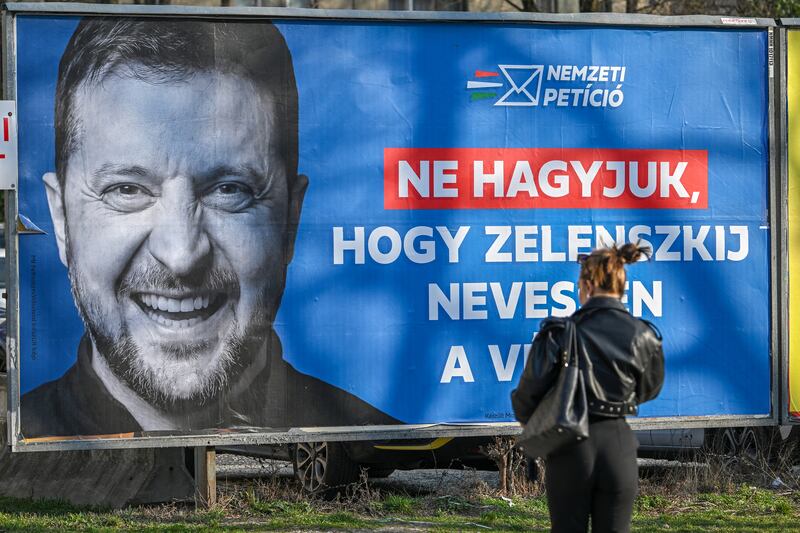
He has also intensified a campaign vilifying Ukrainian and EU leaders allegedly wasting taxpayer money – on one billboard flushing it down a golden toilet – and AI-generated videos showing Hungarian soldiers dying on the Ukrainian front.
The US, UK and several other western countries added the Russian agency and its senior leadership to their sanctions lists in 2024 for running an extensive online campaign known as Doppelgänger, which posted fake news and AI-generated deepfakes to stoke anti-Ukrainian sentiment.
Mindful that overt Russian interference could backfire against Orban, the Social Design Agency has not liaised with the Hungarian government directly and set out plans to contact local influencers through go-betweens, the people said.
Russians see Orban’s governing vision as partly inspired by Putin but are eager to avoid drawing direct links between them, according to the proposal.
“While interfering in election narratives, one should take into account that direct support from Russia could have the opposite effect,” the proposal says.
Instead, the campaign aims to portray Orban as a key partner of Donald Trump by showing off their personal ties and claiming the US president is Hungary’s best hope for security and economic stability.
Unlike Doppelgänger, the Hungarian campaign is intended to look native, with the Russian-designed memes, infographics, videos and stories tailored to Hungary. The Social Design Agency began reviewing Hungarian news and think-tank reports in February for ideas and targeted about 50 pro-Orban figures as well as about 30 opposition figures who could be used to propagate its content.
Anti-Ukraine narratives have skyrocketed on Hungarian social media in recent days.
News of Ukrainian nationals transporting cash and gold being arrested by Hungarian authorities last week – only to be later released – was accompanied by fake images of the alleged perpetrators and the loot in a report by Ripost.hu, a pro-Orban tabloid. The Facebook post gathered 130,000 reactions within a few days, mostly from foreign users – an unusual trend on Hungarian social media.
Russia’s ambassador in Budapest, Evgeny Stanislavov, has denied any interference in the campaign. He said Russia only wanted to “ensure normal bilateral relations continue and develop mutually beneficial co-operation”.
The Hungarian government also denied any Russian interference, claiming this was a “leftwing fake accusation” and a “pitiful attempt to divert attention from the threats from Ukrainian president Volodymyr Zelenskiy towards premier Viktor Orban and other attempts to sway the Hungarian election”.
Dmitry Peskov, Putin’s spokesman, said: “You are most likely making mistaken conclusions based on a fake. Unfortunately, this has often happened in recent years. Even with serious publications.”
– Copyright The Financial Times Limited 2026
[ Pipeline row between Ukraine and Hungary escalates into diplomatic crisisOpens in new window ]


