
Warning: this article contains graphic images
Abdullah Hussein al-Akhras’s family knew he died in prison, but they had never seen the photographs of his emaciated body lying on the ground, a handwritten code affixed to him.
The father of two is among a new cache of tens of thousands of images of starved, tortured and murdered detainees who perished in Syria’s Assad-era prisons and detention facilities.
The new photographs could provide more information to family members about the fates of missing loved ones, and more undeniable evidence to the rest of the world about the crimes against humanity and war crimes carried out by the Assad regime, which used detention and torture to instil widespread fear and maintain control.
READ MORE


They were kept on a hard drive by a former colonel in Syria’s military police. The man, who spoke under the condition that he is not named, leaked them to German broadcaster NDR, which shared the photographs with the International Consortium of Investigative Journalists (ICIJ), of which The Irish Times is a partner.
The Irish Times became aware of the existence of the leaked photographs in October and has advocated for consulting victims’ families regarding their release.
The data is also in the possession of the Syrian Centre for Legal Studies and Research, a non-governmental organisation which is led by Syrian human rights lawyer Anwar al-Bunni, as well as the German Federal General Prosecutor. Germany has universal jurisdiction, meaning it can prosecute certain serious crimes carried out anywhere in the world.
The ICIJ has also gained access to tens of thousands of files leaked from Syrian intelligence agencies. It is not clear whether Syrian authorities have the photographs and documents or how they will get them. A list of more than 1,500 names of people who are dead or whose arrests were recorded has been shared with the UN’s Independent Institution on Missing Persons in Syria, the Syrian Network for Human Rights, and survivors-led initiative Ta’afi.
The full number of photographs is significantly larger than the amount smuggled out by a military defector code-named Caesar, the existence of which became known in January 2014, prompting a global outcry.
More than 33,000 photographs of former detainees are included in the new leak, with more than 70,000 photographs in total, and are mostly believed to have been taken in 2015-2024. At least 10,212 detainees are pictured, according to an analysis by journalists. The majority are not identified with names but with numbers on white paper or material affixed to their bodies.
Many of the bodies bear clear signs of torture, including emaciation, bruising, bloodied and swollen faces, bloodied body parts, bandaged limbs, visible lacerations and missing teeth. Nearly half of the bodies are naked and about three-quarters show signs of starvation, according to an analysis of more than 540 photographs by journalists from NDR, German newspaper Süddeutsche Zeitung and ICIJ. Two-thirds show signs of physical harm.
The man who supplied the photographs led the “Evidence Preservation Unit” of the military police in Damascus in 2020 until December 2024. In an interview with NDR he said he was leaking the data – which had been stored on a hard-drive in his possession – because he finally had the opportunity to do so when the regime fell. “There are matters that people have to know. Dead people, their families have to know where they are. Missing people.”
His department’s role, he said, was “documentation”: recording “every incident that happens in Damascus and the countryside of Damascus in pictures”. That included taking photographs of dead “security detainees”, usually in Harasta hospital. “Everything is official,” he said.

Reporters from the ICIJ believe the photographs include victims from at least six different security branches. The numbers on the bodies appear to indicate both a branch code and a death sequence number. The photographs also include metadata, including a date and time, though it is not clear if this is always accurate.
Many of those photographed in clothes have their trousers and underwear pulled down and their T-shirts pulled up, to expose their torsos. Some were photographed with someone else’s feet touching their head (it is not clear if this was to steady them, or meant as a sign of disrespect). Some were photographed with other corpses visible beside them, with photographs of different bodies taken seconds apart, according to the metadata.
‘He didn’t harm anyone’
In a humble home in the Syrian town of Ghabagheb, in Daraa, Akhras’s family flinched in horror as they recognised him in the photographs, which they had never seen before.
His sister, Mariam al-Akhras (35), began to cry. “He was really a very kind person, he didn’t harm anyone in his life,” she said. Other family members immediately asked whether there were more pictures of other people: they have other missing relatives and are desperate for information about them too.

Akhras – a former conscript turned military defector, born in 1992 – was arrested and imprisoned by the regime in September 2023. Shortly before, he was caught in Turkey attempting to find a route to Europe and deported to Syria. His father and wife visited him six times in the notorious Sednaya prison, but those visits lasted minutes and the jailers stood right beside him, recalled Marwa Jamal el-Ali (32).
When she asked her husband how he was, he could just say “everything is okay” but he looked “tired” and asked for medicines.
[ Sally Hayden goes inside Syria’s Sednaya prisonOpens in new window ]
“When I met him for the last time he was in a very bad health condition, he was not able to stand,” said his father, Hussein al-Akhras (64).
Akhras’s family sold property to pay bribes, realising this might be the only way to save his life: his father estimates they paid at least 65,000,000 Syrian pounds in total. Yet his son died shortly after their last visit. Chaker Moussa Alhboes (38), a neighbour who was imprisoned in Sednaya at the same time, said all detainees were starved and beaten, and Akhras was denied medical care.
Unlike many other families, Akhras’s were informed he had died and were allowed to collect his body. They believe this was because they had paid so much money in bribes and his case was still going through an official legal process. When they received his body there was no trace of the code it had been officially photographed with.

Now they are calling for accountability and justice, as well as help and assistance for the family.
“Everyone who took money” should be held accountable, said Marwa. “The smugglers who took money, the judges, the soldiers ...”
“We need trials for everyone who was in this failed corrupt state,” said her brother, Ahmad Jamal el-Ali.
The Caesar photos
The Caesar photos – which documented the deaths of about 6,786 people – were taken in May 2011-August 2013 of detainees mostly held by five intelligence branches in Damascus. Their existence became public in early 2014, after military photographer Farid Al-Madhan risked his life to smuggle them out.
Al-Madhan would later testify anonymously in front of the UN Security Council and the US House Foreign Affairs Committee, while the photographs were displayed in locations including the United States Holocaust Memorial museum and the United Nations headquarters in New York.
They prompted a wave of sanctions, named after Caesar, which were passed into law in the US in late 2019. Al-Madhan only revealed his real identity in February this year, following the regime’s fall.

Much of the shocked response to the Caesar photographs was tied to the realisation that the regime itself was documenting and indexing its crimes, with apparent certainty that it could operate with total impunity.
The new photographs are likely to raise more horror that this continued for another decade, and big questions about how much more should have been done to make this system of state-controlled torture and abuse stop much earlier.
Among the photographs are previously unseen pictures of Mazen Hamada, the Syrian human rights activist who became a symbol of his country’s suffering.
Hamada escaped to the Netherlands, but he returned to Syria in 2020 and immediately disappeared. His body was discovered when the Assad regime fell, and he was given a funeral days later. He appears to be wearing the same clothes in the photographs found in the database and those taken when his body was eventually found.
If accurate, the metadata from the leaked photographs mean he was dead by September 28th, 2024, rather than dying in the days before the regime fell in early December 2024, as was previously reported.
‘A system of state terror’
About half a million people were killed over nearly 14 years of war in Syria – including more than 200,000 civilians killed by the Assad regime – while more than 160,000 people were forcibly disappeared by the regime between 2011 and last year, according to the Syrian Network for Human Rights.
By 2016 the United Nations Human Rights Council had already determined that the Syrian regime had carried out “the crimes against humanity of extermination, murder, rape or other forms of sexual violence, torture, imprisonment, enforced disappearance and other inhuman acts” regarding its treatment of detainees, along with war crimes.
“We really haven’t seen anything quite like this since the Nazis,” said Stephen Rapp, a former US war crimes ambassador-at-large, about the Assad regime’s crimes last year.
“From the secret police who disappeared people from their streets and homes, to the jailers and interrogators who starved and tortured them to death, to the truck drivers and bulldozer drivers who hid their bodies, thousands of people were working in this system of killing. We are talking about a system of state terror, which became a machinery of death.”


In the days after the regime fell, tens of thousands of Syrians made their way to security branches, hospitals and the notorious Sednaya prison, searching for any trace of their missing loved ones.
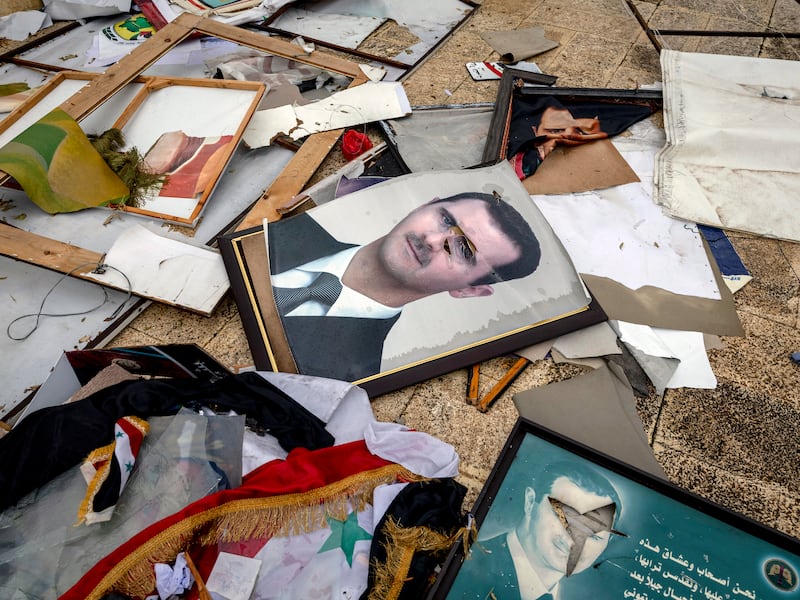
Hundreds of posters were stuck to walls in central Damascus and other cities, bearing pictures of the missing and the phone numbers of relatives.
Mass graves also began to be discovered, with some family members even digging themselves in an attempt to find information about the fates of their loved ones. For many, there soon came the realisation that answers may not be forthcoming. Some of those affected may now find answers in the new photographs, though these are also certain to cause immeasurable suffering too.
Along with ousted president Bashar al-Assad, many former senior regime officials fled to Russia, and some to Lebanon, while others remain unaccounted for.
There are questions about how the new authorities will deal with issues such as transitional justice, in a country still devastated by almost 14 years of war. One of those questions regards where all of the missing have been buried. When The Irish Times visited the site of a mass grave in Damascus neighbourhood Tadamon, six months after the regime’s fall, it had not been secured and human bones were visible on the ground.
Two new commissions have been set up, focused on transitional justice and the search for the missing. But some family members say they have been disappointed with the lack of engagement by the new authorities.
Seeking justice
One big difference is how the families of the missing can now come together and speak freely inside Syria. Members of the Caesar Families Association recently gathered in the organisation’s new office in Damascus, to talk to The Irish Times.
They are still reeling from the repercussions of the last leak of photographs. While Bashar al-Assad dismissed the images as “fake news” during a 2017 interview with Yahoo News, distraught families continue to find missing loved ones in the database.

Over the past four years the Caesar Families Association has begun using facial recognition software to help narrow down the number of pictures that any family member would have to look at, in an attempt to reduce the trauma. It is not clear whether the association will have access to the new database, though perhaps that technology could be helpful from an earlier stage this time.
Fauziah Alallawi, a 23-year-old medical student, only discovered her father’s photograph after the regime fell: before that, it was too dangerous to look for it inside the country. Afterwards, “my relatives, my cousins and my aunts asked me to send the photo to them. I told them no, please keep the beautiful image about my father, his charisma.”
She wants justice, but sees it as vitally important that any trials be held in Syria, with Syrian judges and lawyers. “We have a lot of efficient and qualified people ... When we build our narrative and history, it’s very important for us to have it as Syrian. [It was the] Syrian people [who] overthrew the regime ... The identity of Syria should be built on that.”
Summar al Saad (36), whose brother was in the photographs, said it is best not to make any new database public because of how traumatising it can be for a family. Instead, there should be a mechanism or institution that has the full set and allows one family member to identify the person pictured, she suggested.
“For me it was very important to find the picture of my brother and see it,” said Fadi Alabbir (38). “It was a relief for me, I spent four or five years looking for my brother and wondering if he was alive.”
Lubna al Masri, whose husband was photographed, said such images need to be public in some way, maybe even displayed in an exhibition “because even today people don’t believe these pictures”. She believes the regime would not have collapsed without the initial photographs being released. “But of course it should be done properly.” She said an organisation should do an analysis and inform family members. “Not ... publish it [all] on the internet.”
She too longs for Syrian trials that victims and their family members could attend.
“We want to build our state and our nation on justice ... I think that everyone who worked in intelligence and military branches should be held responsible, from the smallest employee to the top ...
“If we don’t hold everyone accountable inside Syria we will lose the cause. The people who come in the future will say it happened before and no one did anything. So justice has to prevail.”


