

The United Nations Security Council convened on Monday to hear widespread condemnation of Israel’s decision to recognise Somaliland, which broke away from Somalia 34 years ago, as an independent country.
Israel and Somaliland will open up embassies, and Somaliland has also expressed its intention to join the Abraham Accords, under which several states established diplomatic relations with Israel.
Why did Israel become the first UN member state to recognise Somaliland?
The strategic importance of Somaliland is clear. Somaliland lies in northwestern historic Somalia and stretches along hundreds of kilometres of coastline on the Gulf of Aden, directly opposite Yemen. The area, in northeast Africa, sits astride a critical shipping route leading to the Bab el-Mandeb Strait, a chokepoint through which a significant share of maritime trade between Asia and Europe passes via the Suez Canal.
Since Iranian-backed Houthis in Yemen began attacking vessels in the Red Sea following Hamas-led October 7, 2023, attack and the ensuing Gaza war, many shipping companies rerouted around the Cape of Good Hope, off the southern tip of Africa, at heavy economic cost that has also affected the Israeli market.
READ MORE


Why has Binyamin Netanyahu moved now?
Israel’s surprise recognition of Somaliland, announced by prime minister Binyamin Netanyahu on Friday, should be seen as part of Tel Aviv’s struggle for regional influence against two main adversaries, Iran and Turkey.
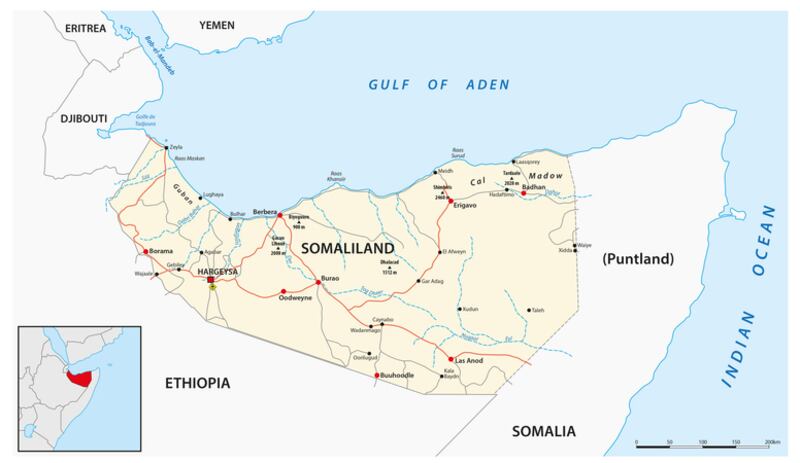
It puts Israel into the mix of the extremely complex, ongoing power struggles for control of the Horn of Africa, which involve shifting alliances linked to Somalia, Ethiopia, Yemen, Saudi Arabia, the United Arab Emirates (UAE), Turkey, Iran, Egypt and others.
During the Gaza war, Israel carried out long-distance air strikes in Yemen in retaliation for the hundreds of missiles and drones that were launched at Israel by the Houthis. With the Gaza ceasefire these tit-for-tat strikes have ended, but they may well resume if the Gaza ceasefire collapses or Israel again targets Iran.
Will Israel now have a military foothold in the region?
As far as we know, Israel’s recognition of Somaliland was not linked to a formal promise by Hargeisa, the capital of the breakaway region, allowing Israel to establish a military presence, but such a development would hardly come as a surprise and could be used by Israel as a forward base for future military strikes against the Houthis.

A year ago, the Middle East Monitor reported how the UAE, a key Gulf ally of Israel, was negotiating with Somaliland over allowing Israel to set up a military base in that country in exchange for Israeli recognition of its independence.
Israel’s military participation in the strategic network the UAE is building around Yemen (where it backs anti-Houthi factions) and the Horn of Africa could put both countries on a collision course with other states seeking regional influence, first and foremost Turkey.
Ankara is expanding its presence in African countries that border the Gulf of Aden and the Bab el-Mandeb Strait. The largest Turkish military base outside Turkey, as well as the largest Turkish embassy, are located in Somalia, where 15,000 Somali soldiers have been trained by the Turkish at that base since 2017. Somali officers have undergone advanced training in Turkey.
What’s in this for Somaliland?
For Somaliland, Israel’s decision marks a historic breakthrough that it hopes will encourage other countries, notably the United States, to follow suit, although US president Donald Trump’s initial response (“Does anyone even know where Somaliland is?”) is hardly encouraging.
For Israel, it is a calculated gamble in a volatile arena that could expand its influence, but it could also backfire. The Houthis have already made it clear that any Israeli presence in Somaliland would be considered a legitimate military target.
An already-volatile part of the world may be about to become even less stable.


