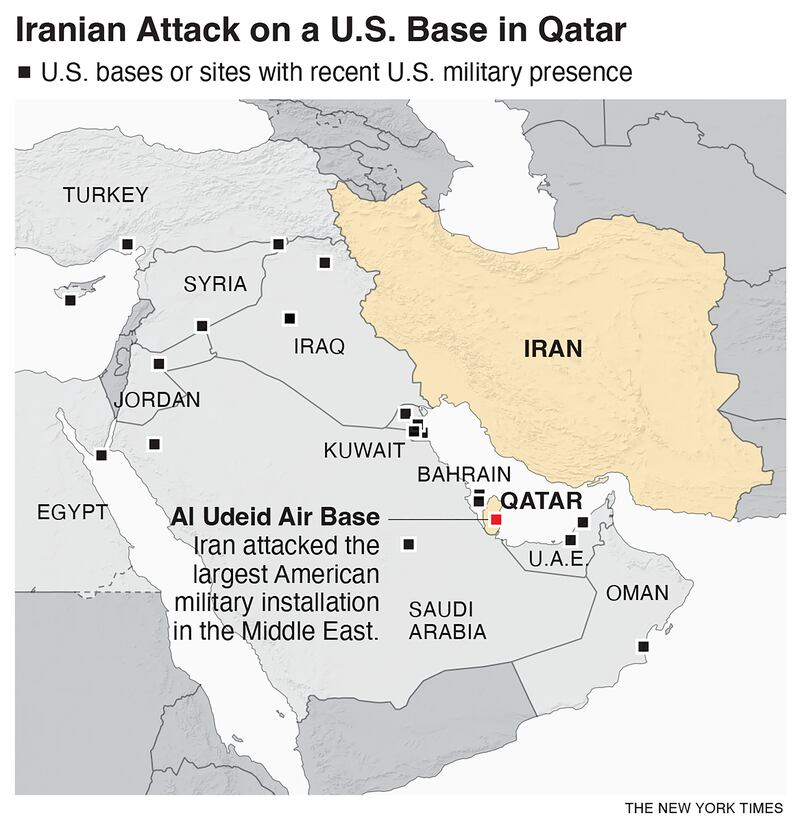
The United States has evacuated some personnel from a military base in Qatar as countries around the region race to defuse the risk of conflagration from any strike against Iran by Donald Trump.
The withdrawal from the Al Udeid airbase, the US’s regional military command which hosts around 10,000 troops, was described by an Arab official as a “precaution as of now”.
“There are some people leaving” the base, a US official said. The Qatari government said the measures were being undertaken “in response to current regional tensions”.
The move comes amid growing concern that instability could spill over into neighbouring countries, including Turkey and in the Gulf, if the US president follows through on his repeated pledges to intervene to support the anti-regime demonstrations that have swept Iran since December.
READ MORE


Iran previously targeted Al Udeid with a missile barrage after the US bombed its nuclear facilities during Israel’s 12-day war against the Islamic republic in June.
[ How Iran cut off the internet – and Iranians reconnected to the worldOpens in new window ]
Mohammad Marandi, a hardline politician and university professor in Iran, appeared to suggest in a post on X that Tehran could try to repeat such an attack.
“Everyone should immediately leave the countries in the Persian Gulf that host US bases,” he said.
US Central Command, which oversees military operations in the Middle East, declined to comment on the personnel withdrawal at Al Udeid.
Mediation efforts have picked up since the protests spiralled last week, and Iranian officials have held talks with countries including Qatar, the United Arab Emirates and Turkey, all of which host significant US military bases.
Human rights groups overseas estimate that thousands of protesters have been killed in the demonstrations, which have escalated into the most severe anti-regime unrest since the Islamic Revolution in 1979.
Mr Trump on Tuesday appeared to suggest that US action in Iran was imminent, posting on his Truth Social platform that “HELP IS ON ITS WAY”.
He added that he had scrapped all meetings with Tehran’s officials until the “senseless killing of protesters” ended and would “take very strong action” if the regime carried out executions of people detained during the rallies.
Turkey’s foreign minister, Hakan Fidan, has spoken twice with his Iranian counterpart Abbas Araghchi over the past 24 hours. During both telephone calls, Mr Fidan emphasised the need for negotiations to resolve existing regional tensions.
Although Ankara and Tehran have long been regional rivals, Turkey is concerned that the violent overthrow of the Iranian Government could spark mass instability in its neighbour and a massive refugee exodus.
Mr Fidan accused Iran’s rivals of trying to exploit the unrest and pointed at Israel’s intelligence agency Mossad. “They are calling on the Iranian people to revolt against the regime through their own internet and Twitter accounts,” he said in a television interview.
The US has several military bases in Turkey, many of them used for Nato operations. These include the Kürecik radar station in southern Turkey and the Incirlik airbase in central Turkey, a joint US-Turkish installation that hosts American nuclear warheads and has been used to support the international coalition fighting Islamic State in Syria and Iraq.
Gulf officials have insisted that they would refuse any US request for their territory to be used in any strike against Iran. Iran has also long been a rival of Gulf Arab states, but Saudi Arabia and the United Arab Emirates have embarked on a detente with the Islamic republic in recent years.
[ A collapse of Iran’s regime requires two crucial conditionsOpens in new window ]
While Saudi Arabia and its Gulf neighbours prefer a weakened Iran, they remain concerned about the destabilising impact of regime change in Tehran and Trump’s unpredictability.
Regional officials fear that any US intervention targeting the regime, rather than its nuclear facilities as during last June’s strikes, could spark a more serious Iranian response.
Ali Shamkhani, a security adviser to the supreme leader, warned the US in a post on X not to underestimate “Iran’s real determination and capability to respond to any aggression”.
Iranian officials have previously threatened to disrupt shipping lanes in the Strait of Hormuz, a global chokepoint for oil supplies.
“The diplomatic push is to cool things down – if Iran were to play the Hormuz card: that is where the real danger comes from,” said another Arab official.
Saudi Arabia would not countenance offering any assistance for potential US air strikes on Iran, said one person close to the royal court. Nor is Riyadh expecting the protests to lead to a revolution, given that Iran will “fight back aggressively”, they added.
The person also reflected widespread regional concerns that the Iranian regime, under pressure internally and externally, could respond militarily against its neighbours.
“No one wants a wounded tiger in the corner, lashing out at everyone,” he said. “A decapitation of the regime would really make a difference – but that isn’t on the cards. There is very little the Americans can do to bring down the regime with air power.”
– Copyright The Financial Times Limited 2026