Main points
- The US and Israel are continuing to attack Iran as the conflicts spill over into neighbouring countries
- At least 52 people were killed and more than 150 injured by Israeli strikes in Lebanon after retaliatory Hizbullah attacks
- Earlier US president Donald Trump said Iran “refused to cease their pursuit of nuclear weapons”, claiming the regime “would soon have had missiles capable of reaching our beautiful America”
- Global oil prices jumped when markets opened on Monday
- Contingency planning for the evacuation of potentially hundreds, and perhaps thousands, of Irish citizens from the Middle East is under way
Key reads
- Why have the US and Israel attacked Iran? Why has Dubai been hit?
- In maps: How war on Iran is spreading across Middle East
- How will household bills be affected by unrest in the Middle East?
Jack Horgan-Jones and Harry McGee write: Consideration is being given to bussing Irish people stranded in the United Arab Emirates to Oman before flying them home if flights remain heavily restricted from the UAE.
Senior officials and ministers met in Dublin on Monday to discuss the escalating crisis in the region after a combined US-Israeli attack on Iran which killed Iranian supreme leader Ali Khemenei and other regime leaders.
Minister for Foreign Affairs Helen McEntee, Taoiseach Micheál Martin and Tánaiste Simon Harris were briefed by the Defence Forces chief of staff and officials on Monday, discussing the consular response and contingency planning – as well as the situation with Irish troops serving with Unifil in Lebanon, all of whom are reported as safe.
With only minimal flights taking off from the UAE, up to 22,000 Irish citizens are stranded in the region – some being residents and others transiting through the middle eastern hub or there for short visits.
It is understood that the main concern for Ireland is if the UAE begins to respond to missile and drone strikes launched on its territory by Tehran, which has been firing at US allies in the region since it was attacked on Saturday.
Among the contingencies being discussed is arranging bus transfers for Irish people to Oman, where airspace is less restricted, to be met by charter flights contracted by the Irish government. Irish officials expect the conflict to continue for several weeks, with concerns that evacuations from the UAE could become more difficult still if it responded to strikes.
Financial assistance for those stranded would also be considered, a senior source said, if it became necessary - although many are being put up in hotels in the Emirates without charge.
Lists are being compiled of vulnerable Irish people in the region, including the elderly or sick, who may need to be prioritised.
White House press secretary Karoline Leavitt has said “killing terrorists is good for United States”.
She noted “49 of the most senior Iranian regime leaders” have been killed in the strikes on Iran.
In a social media post, she outlined the objectives for the US operation, which included “preventing this radical regime” from threatening the country.
She said the Iranian leaders including supreme leader Ayatollah Ali Khamenei – “have already been wiped off the face of the Earth so far in the opening strikes of Operation Epic Fury.”
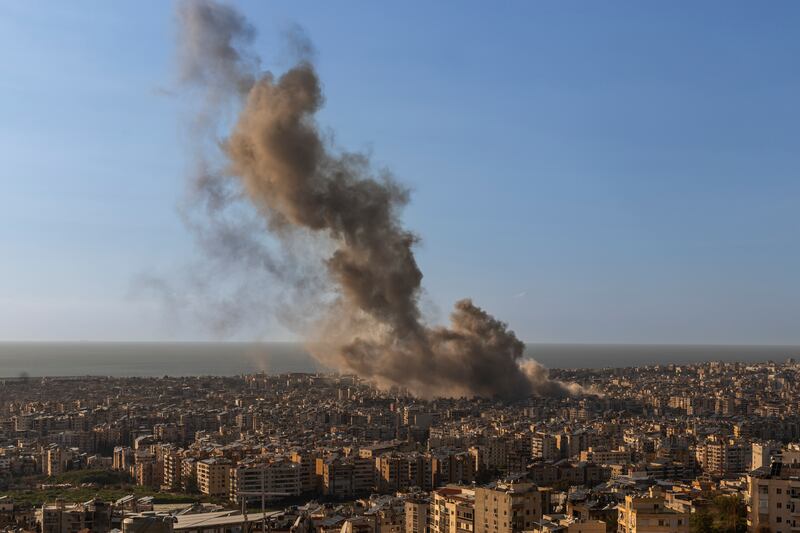
At least 52 people were killed in Lebanon and more than 150 injured after Israel responded to Iranian-backed Hizbullah attacks.
Hizbullah said its attack on Israel was in response to Israel’s assassination of Iran’s supreme leader, Ayatollah Ali Khameini, on Saturday morning, an action the militant group said “crossed a red line”.
Israel Defense Forces (IDF) responded with a wave of strikes throughout Lebanon, including in Beirut’s Dahiyeh quarter.
The attacks continued throughout the day. Huge traffic jams were reported as residents fled.
The Israeli air force and navy said dozens of Hizbullah targets and what were described as “Iranian regime command centres” were struck, including a weapons storage site in the Tyre area in southern Lebanon. Money exchange shops that Israel claimed were used by Hizbullah for money laundering were also hit.
The Hizbullah decision to attack Israel came despite intense pressure on the group from the Lebanese government, which wanted to avoid the country being dragged into another confrontation with Israel. A ceasefire in December 2024 ended a war between Israel and Hizbullah.
Could drone attacks lead Cyprus to trigger an EU common defence clause?
Drone attacks targeting military bases in Cyprus have opened the prospect the EU state may trigger a “common defence clause”.
The defence has only been used once before in the bloc’s history, Europe Correspondent Jack Power writes.
An Iranian-made drone hit a British military airbase in Cyprus on Sunday, causing a small amount of damage, but no injuries. Two further unmanned drones were intercepted heading towards the Mediterranean island on Monday.
The apparent target, Akrotiri, is one of two RAF bases on the island, which are sovereign British territory under the terms of a 1960 agreement that saw the former British colony granted independence. The UK government has shown no interest in giving up the small tracts of strategically important territory close to the Middle East.
The current situation is exactly the kind of scenario Cyprus wanted to avoid. Senior figures in the government in Nicosia had worried the British bases could become a target, in a volatile military conflict involving the US, Israel and Iran.
Greek defence minister Nikos Dendias said Athens was sending two frigates and a pair of F-16 fighter jets to Cyprus, to aid its defences.
The drone attacks, particularly should they intensify, will spur debate in Brussels about co-ordinating further help at EU-level.
It would be open to Cyprus to trigger a mutual defence clause in the EU treaties. That commits other EU states to provide “aid and assistance by all the means in their power”, to a member under attack.
It has been triggered just once before, by France in the immediate aftermath of the 2015 Paris terror attacks. That was to send more of a political message, than a request for practical support. The limits of the defence clause remain untested.
“For the moment no such discussion has taken place on the activation of the mutual defence clause, we will have to see if that is the case in the coming days” a European Commission spokeswoman said on Monday.
The clause does not bind EU states to military action. It contains an asterisk that effectively recognises the neutrality of Ireland, Austria and Malta.
One Cypriot source said the government in Nicosia was assessing the situation as things evolved.
Concerns grow about inflated fuel prices
Conor Pope writes: With the conflict in the Middle East already putting pressure on global fuel prices there are concerns some suppliers might be using the crisis to artificially inflate the cost to consumers, a practise which has been dubbed “disgraceful”.
Labour’s enterprise spokesperson George Lawlor has demanded urgent Government action following reports that home heating oil suppliers have increased their prices in response to events in Iran.
He said homeowners are already reporting higher quotes for home heating oil and warned that profitable energy firms must not exploit global instability to heap further pressure on families already struggling with the cost of living.
He called on the Government to set out what immediate steps they will take to prevent price gouging and protect hard pressed households.
He said prices climbing higher so soon after the conflict started “looks and feels like opportunism. These are outrageously profitable companies. They do not need an excuse to pad margins. The idea that global tensions become a green light for immediate price hikes for home heating oil is disgraceful.”
Iran ‘refused to cease their pursuit of nuclear weapons’, says Trump
Trump has provided an update on the US strikes in Middle East saying the campaign was designed to prevent Iran gaining nuclear weapons and was “already substantially in advance of our time projections.”
Speaking in the East Room of the White House where he posthumously honoured US service members with the US Medal of Honor, Trump said “the United States military continues to carry out large-scale combat operations in Iran to eliminate the grave threats posed to United States by this terrible terrorist regime.”
Trump said his administration had warned Iran not to make any attempt to rebuild nuclear its capability after Operation Hammer, the US’s previous strikes on Iran, last year.
“But they ignored those warnings and refused to cease their pursuit of nuclear weapons,” Trump said.

“In addition, the regime’s conventional ballistic missile program was growing rapidly and dramatically, and this posed a very clear, colossal threat to United States and our forces stationed overseas.”
He claimed “the regime already had missiles capable of hitting Europe and our bases, both local and overseas, and would soon have had missiles capable of reaching our beautiful United States.”
“Our country itself would be under threat, and it was very nearly under threat,” he said.
“An Iranian regime armed with long range missiles and nuclear weapons would be an intolerable threat to the Middle East, but also to the American people. Our country itself would be under threat, and it was very nearly under threat.”
Trump said: “Our objectives are clear. First, we’re destroying Iran’s missile capabilities, and you see that happening on an hourly basis, and their capacity to produce brand new ones and pretty good ones they make. Second, we’re annihilating their navy. We’ve knocked out already 10 ships. They’re at the bottom of the sea.
“Third, we’re ensuring that the world’s number one sponsor of terror can never obtain a nuclear weapon. Never going to have a nuclear weapon. I said that from the beginning, they’re never going to have a nuclear weapon. They were on the road to getting one legitimately through a deal that was signed foolishly by our country. And finally, we’re ensuring that the Iranian regime cannot continue to arm, fund and direct terrorist armies outside of their borders.”
Trump also said the campaign was “substantially in advance of our time projections.” He said “we projected four to five weeks, but we have capability to go far longer than that. We’ll do it.”
“We also projected four weeks to terminate the military leadership, and as you know, that was done in about an hour. So we’re in advance of schedule there by a lot.”
US secretary for defence Pete Hegseth has said the military action in the Middle East is not set to be a protracted conflict.
“This is not Iraq. This is not endless,” he said.
Hegseth, along with US air force Gen Dan Caine, chairman of the Joint Chiefs of Staff, was speaking at the Trump administration’s first news briefing since Saturday’s strikes.
US president Donald Trump has not taken questions on camera and only released two videos since the operation began.
Hegseth said the operation had a “clear, devastating, decisive mission” to “destroy the missile threat” from Iran, destroy its navy and “no nukes.”
“No stupid rules of engagement, no nation building quagmire, no democracy building exercise, no politically correct wars. We fight to win, and we don’t waste time or lives,” Hegseth said.
“Iran was building powerful missiles and drones to create a conventional shield for their nuclear blackmail ambitions,” Hegseth said.
He said that during negotiations with US officials leading up to the attack, Iranian officials were “stalling.”
“The former regime had every chance to make a peaceful and sensible deal. But Tehran was not negotiating,” Hegseth said.
Caine, in laying out a timeline for the operation, said the president gave the go-ahead order for the strikes at 3.38pm EST on Friday. That meant the president gave the signal when he was aboard Air Force One heading to Texas with Republican senators Ted Cruz and John Cornyn and actor Dennis Quaid.
Trump, in an interview with The New York Times, on Sunday, said the assault could last “four to five weeks”.
Radha Stirling, founder of Detained in Dubai and chief executive of Due Process International, has asked Gulf authorities to address the issue of foreigners who have been issued with travel bans, when it potentially comes to evacuation.
The UK government, for example, is examining possible evacuation routes for UK citizens, as part of emergency contingency plans should conditions deteriorate further.
Stirling said thousands of foreign nationals were subject to travel bans in Gulf states, due to ongoing legal proceedings, which legally prevented them from leaving.
Stirling called for emergency humanitarian exemptions to allow restricted individuals to depart until the security situation stabilises.
“It is unreasonable to maintain administrative travel bans while missiles are crossing regional airspace,” she said.
“Many of these individuals are not convicted criminals. They are businesspeople, residents or defendants awaiting proceedings. If commercial evacuation routes open, they should not be left behind purely because of procedural restrictions.
Downing Street has said it is will allow British airbases to be used by US warplanes to strike Iran for “specific limited defensive purposes,” London editor Mark Paul has said.
UK prime minister Keir Starmer initially refused to get involved in the air strikes that started on Saturday.
He also refused to allow the US to use the Diego Garcia base on the Chagos Islands as a launch pad for the strikes.
On Sunday, however, Starmer appeared to do a U-turn when he announced that UK bases could now be used by US warplanes to strike Iranian missile depots and launch sites, but only as a measure to protect the safety of the 200,000 British citizens in the region.
UK warplanes will not strike themselves inside Iran, but will continue to try to take out Iranian drones and missiles in the air,
Westminster journalists were told at a briefing on Monday morning. Starmer is expected to address the House of Commons at 3,30pm on Monday afternoon about the crisis.
The Irish Government has started contingency planning for the evacuation of potentially hundreds, and perhaps thousands, of Irish citizens from the Middle East, writes Harry McGee.
Minister for Foreign Affairs Helen McEntee said that there were as many as 22,000 Irish citizens in the region at present – most residing in the Gulf States.
She urged all of them to register to give her Department “a complete picture of who exactly is in the region.
“Obviously, the longer this goes on, the more distressing it is for people, not just for those in the region, but for the family members here who are trying to get them home and are concerned as to how this may escalate.”
McEntee said the reason people were being asked to register was so that we have a full and complete picture of those living in the region, who are transiting, and those who are on holidays.
“Our team here in Ireland is working around the clock to make sure we can answer calls and respond to calls,” adding that the calls had numbered in the hundreds as opposed to thousands.
Dubai Airports say “a limited resumption” of flights will begin this evening, with a “small number of flights” from Dubai International (DXB) and Dubai World Central – Al Maktoum International (DWC).
But they tell travellers not to travel to the airports unless contacted by their airline with a confirmed departure time.
Germany will send planes to evacuate tourists stranded in the Middle East, its foreign minister says.
Benchmark Dutch and British wholesale gas prices soared by almost 50 per cent on Monday, after major liquefied natural gas (LNG) exporter Qatar Energy said it had halted production due to attacks in the Middle East.
Qatar, soon to cement its role as the world’s second largest LNG exporter after the United States, plays a major role in balancing both Asian and European markets’ demand of LNG.
Europe has increased imports of LNG over the past few years as it seeks to phase out Russian gas following Russia’s invasion of Ukraine.
Around 20 per cent of the world’s LNG transits through the Strait of Hormuz and a prolonged suspension or full closure would increase global competition for other sources of the gas, driving up prices internationally.
Not many people will be shedding a tear for the demise of Ayatollah Ali Khamenei, Tánaiste Simon Harris has said.
Asked why the Irish Government had not condemned the unprovoked attack by the United States and Israel on Iran, as it had done with Russia’s invasion of Ukraine, Harris said that Ukraine was in no way comparable to what he called the “despotic regime” in Iran.
“I think there’s complexity here. The (Iranian) regime that slaughtered so many of its own people, it is a regime that had no respect for human rights, for women, for protest.
“I think the far left should slow down in rushing to judgment.”
Harris, also Minister for Finance, said that as an open island economy, the Government had to monitor very carefully the potential impacts the escalating conflict would have for Ireland.
He maintained there would be “plenty of time for examination and consideration of the rights and wrongs of certain actions” and added the priority of the Government at the moment was to argue for de-escalation and restraint.
“We are very intensively engaging with EU counterparts ... and putting forward the case for de-escalation. Every conflict ultimately has to be resolved through dialogue. There were active negotiations under way to try and find a way where Iran can never have nuclear weapons (or) capability.
“That’s absolutely essential to the interests of the world. Ireland has long held that position, and indeed, Ireland has played a very proud role in trying to lead the conversation over decades in relation to this.”
Some takeaways as the phrase goes from the joint press conference held by US defence secretary Pete Hegseth and chairman of the joint chiefs of staff Dan Caine.
Hegseth said the Iranian operation is not “endless war” as Iraq and Afghanistan had been.
“Our generation knows better, and so does this president. He called the last 20 years of nation-building wars dumb, and he’s right. This is the opposite. This operation is a clear, devastating, decisive mission. Destroy the missile threat, destroy the navy, no nukes.
“This is the generational turning point America has waited for since 1979 and since the rudderless wars of hubris, my generation, our generation, endured.”
Caine said the go-ahead for Operation Epic Fury started at 1.15am Washington time commencing with a daylight strike conducted by Israeli forces acting on US intelligence. This was the attack that killed Iranian supreme leader Ayatollah Khamenei.
Caine maintained the integrated air and missile defence network is performing exactly as it’s intended. “I wish that every American could hear the voice communications, like I have, as these joint operation centres remain calm, focused, and cool, while executing under fire, over and over again.”

US systems have intercepted hundreds of Iranian drones and missiles, and he added: “We remain vigilant in the counter-UAV [unmanned aerial vehicle] fight.”
The United States was not alone in its efforts, and its allies in the Middle East were co-ordinating their anti-drone efforts, Caine stressed.
He also suggested the incident on Saturday that has now killed four US service personnel was not from enemy fire.
Nerves have predictably hit oil and gas markets as they reopened after the weekend, writes Cliff Taylor.
The two big issues are the disruption of supplies through the Strait of Hormuz, the only route out from the Gulf, and the risks to production infrastructure. Iranian attacks today on a Saudi refinery and a Qatari LNG plant show they are targeting key facilities and sent prices higher, particularly on gas markets. You can read his analysis here.
US defence secretary Pete Hegseth has said the goal of Operation Epic Fury is twofold – one to get rid of Iran’s nuclear threat, the second to get rid of its conventional weapon capacity.
Hegseth said the Iranians were building up a huge arsenal of drones and missiles to protect their nuclear programme.
He believed president Donald Trump had given the Iranians “every opportunity” to make a deal on their nuclear programme, but they had rejected it.
US chairman of the joint chiefs of staff Dan Caine has said the American people can “expect additional losses” in the Middle East following the attack on Iran.
He said the attack that killed Iranian supreme commander Ayatollah Khamenei along with many other members of the regime was a “single, synchronised event” with more than 100 aircraft involved.
It was a “massive, overwhelming attack” designed to disrupt the Iranian command-and-control systems. “We ensured that our enemy would see only speed, surprise and the violence of action.”
Operation Epic Fury demonstrated the capability of the US military in conjunction with its partners in the Middle East, he added.
“Operation Epic Fury shows the ability that the United States military can uniquely deliver. It reflects years of investment and integration. To those who would test our resolve, understand clearly we can reach you, we can sustain the fight and we can scale the fight and we will prevail.”
US president Donald Trump said the bombing campaign against Iran could last for weeks and called on the nation’s leaders to capitulate, but the Islamic Republic’s security chief ruled out negotiations.
The conflict continued to reverberate across the Middle East on Monday, with blasts heard across Israel, Saudi Arabia, Qatar and the United Arab Emirates, as states intercepted Iranian missiles launched in response to US-Israeli strikes.
Oil surged the most in four years and airlines suspended flights, causing major disruptions at some of the world’s busiest airports.
The US said three fighter jets crashed in Kuwait due to an apparent friendly fire incident. Israel expanded its campaign to Beirut after coming under attack from Hizbullah fighters in southern Lebanon, who are allied with Tehran.
Oil traded about 10 per cent higher near $80 a barrel as traders gauged the impact of the war on energy flows, with tanker traffic through the vital Strait of Hormuz at a near halt.
QatarEnergy suspended production of liquefied natural gas due to attacks on its facilities, while operations were paused at Saudi Arabia’s largest refinery after a drone strike. Fuel prices soared across global markets. Stocks tumbled.
Trump called on Iran’s generals to hand power to the nation’s people and said he’s agreed to talk to new leadership after the weekend killing of supreme leader Ayatollah Ali Khamenei, according to the Atlantic.
Iran’s security chief, Ali Larijani, said Tehran won’t negotiate with the US, responding to reports that he had reached out to American officials through Omani mediators.
Over the past 48 hours, Trump has made various and sometimes contradictory statements on the attack, including that it could end in a few days or last four to five weeks. He’s listed aims such as the freedom of Iranians and preventing the country from having long-range missiles and nuclear weapons. He’s also said he could cut a deal with the Islamic republic.
The impact of the escalating conflict on the Strait of Hormuz heightened concerns that shipments from some of the world’s largest energy exporters could be disrupted.
Investors reacted to the weekend events by shunning risky assets, although trading was volatile. Opec+ on Sunday agreed to resume production increases next month to counter an expected further rally in oil prices.
Trump said the bombing campaign will continue after the US-Israeli alliance struck hundreds of targets across Iran. The US leader said on social media that American forces sank nine Iranian naval vessels and the headquarters of the navy was “largely” destroyed in a separate attack.
“Combat operations continue at this time in full force and they will continue until all of our objectives are achieved,” Trump said. He called on Iranian people to “seize this moment” and “take back your country”.
The US military’s central command announced the first American fatalities on Sunday, saying that three service members were killed and five “seriously wounded”.
“There will likely be more before it ends,” said Trump, who campaigned against the involvement of American soldiers in overseas wars. “That’s the way it is.”
US defence secretary Pete Hegseth has said Iran will not be another Iraq.
Hegseth gave a defiant briefing at Monday’s press conference in which he stated that the United States was finally acting “after 47 years of Iranian belligerence”.
He called on the Iranian people to rise up against its government, and he also called on the Iran security forces to lay down their arms.
“We fight to win and we don’t waste time or lives,” he said.
The US will not be involved in nation building or getting sucked into a quagmire, he stressed.
He warned that anyone who kills or threatens Americans will be hunted down by the US “without apology and without hesitation”.
Hegseth said US president Donald Trump meant what he said about not allowing Iran to have nuclear weapons, but only he had the “guts” to carry it out.
The escalating war in the Middle East is having a serious impact on the aviation and travel industries.
The United Arab Emirates and Qatar have made themselves world hubs for air traffic between Asia and Europe. Dubai, the world’s busiest international hub, and Doha in Qatar remain shut for a third day, leaving tens of thousands of passengers stranded as aviation faced its biggest challenge since the Covid pandemic.
Shares in TUI, Europe’s largest travel company, were down 8.5 per cent in late morning trade, while Lufthansa was down 6.5 per cent and Aer Lingus and British Airways-owner IAG down 4.8 per cent.
Dubai International Airport was hit by an Iranian drone over the weekend and the sight of terrified passengers evacuating its terminals will not help its carefully cultivated image as a hub and tourism destination.
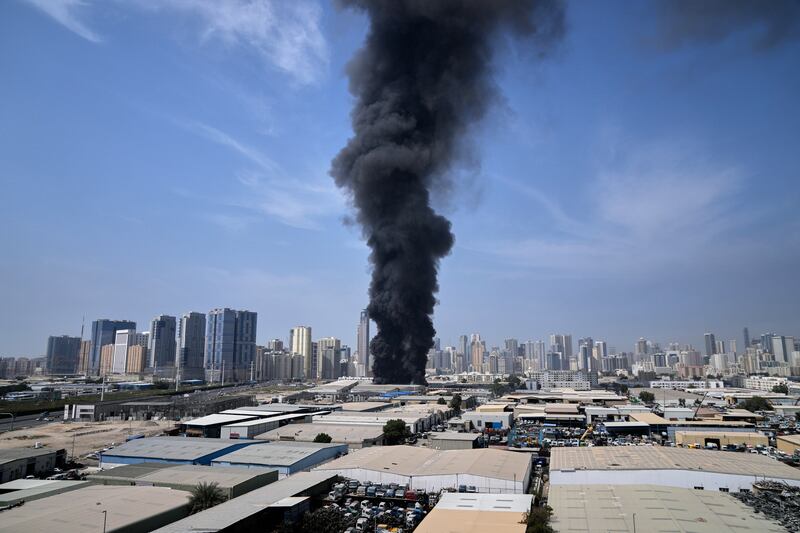
Qatar has just announced that it is temporarily halting the production of liquefied natural gas because of drone strikes by Iran.
QatarEnergy, the state-owned oil and gas enterprise, is responsible for nearly 20 per cent of global LNG exports.
The Qatari government blamed the closure on Iranian drone attacks on QatarEnergy’s operating facilities in Ras Laffan Industrial City and Mesaieed Industrial City.
This could have major implications for the price of natural gas worldwide.
Iran is hitting sites that could cause more damage than just going for tankers.
Stocks fall, oil prices rise
Stocks tumbled and oil prices jumped as the eruption of a military conflict in Iran rattled global markets. Gold and the dollar rose in a rush for havens.
Brent crude traded near $79 a barrel after the conflict effectively shut the Strait of Hormuz – a vital artery off Iran’s coast that carries about a fifth of the world’s oil and significant volumes of gas.
Safer assets drew strong demand as investors cut back on risk. Gold rose more than 2 per cent to nearly $5,400 (€4,600) an ounce. The dollar gained the most in nearly a month.
Three US jets in Kuwait downed by friendly fire
Dramatic footage of a US F-15 jet crashing has been confirmed as a friendly-fire incident.
US Central Command said three jets were hit by friendly fire.
All six crew ejected safely and have been recovered, it says.
Footage verified by several news outlets including CNN shows the apparent moment the fighter jet was downed near Kuwait City.
Iranian drones attacked the Ras Tanura refinery in Saudi Arabia on Monday morning.
The refinery is the oldest in Saudi Arabia and is operated by the country’s state oil company, Aramco.
The Saudi authorities said a small fire at the refinery was caused by falling debris and that two Iranian drones were shot down.
The country’s energy ministry has said “operational units at the refinery were shut down as a precautionary measure”, but there had been no impact on the “supply of petroleum products to local markets”.
While everybody is focused in Ireland on security preparations for our forthcoming EU presidency in July, Cyprus, the current holder, is already experiencing security issues in real time.
The US embassy in Cyprus has advised US citizens to take shelter with a possible drone threat to the Paphos region of the country.
Cyprus, like Ireland, is not a member of Nato though it is having a debate about whether or not to join.
That debate may well be accelerated given that it is now the target of Iranian drones because of the presence of a British Royal Air Force base on the island.

What is president Donald Trump’s endgame in Iran? Our Washington correspondent, Keith Duggan, gives his assessment in our In the News podcast.

European Commission president Ursula von der Leyen has said the world must be prepared for the “fallout” of the war, Irish Times Europe correspondent Jack Power reports from Brussels.
Speaking at a brief press conference this morning, von der Leyen said Iran had to stop in its “indiscriminate” missile strikes across the Middle East.
“In the last hours, we have witnessed numerous attacks, including a drone attack targeting the British airbase in Cyprus,” she said.
The German politician, who leads the EU’s executive body, said she condemned in the “strongest terms” the “indiscriminate” attacks by Iran and its proxies on other countries in the Gulf region, which followed military strikes of the US and Israel.
The situation remained volatile, but there was “renewed hope for the oppressed people of Iran” to be able to “determine their own future”, the commission president said.
Oil and gas prices surged and global stocks fell on Monday as the widening conflict in the Middle East disrupted energy supplies from the region and threatened to hit the global economy.
In the first trading session since the US and Israel launched air strikes against Iran on Saturday, Brent crude, the international benchmark, soared as much as 13 per cent. European gas prices jumped 24 per cent.
Gold rose and global stocks fell, with the Stoxx Europe 600, Europe’s benchmark index, down 1.8 per cent, led by declines in airlines and hotel groups.
The Department of Foreign Affairs has issued updated advice to Irish citizens in the Middle East. The advice is here.
Physicist Dr Patricia Lewis has said there is no peaceful reason why Iran would want to enrich uranium up to 60 per cent.
The process of enrichment of uranium is necessary to create the energy needed for nuclear fuel or a nuclear bomb.
Through the process, pure uranium U238 is partially converted into an isotope U235. You only need to enrich it between 3 and 5 per cent for nuclear power, but a threshold of 60 per cent is worrying, she told RTÉ Radio 1’s Today with David McCullagh Show.
She estimated that Iran has up to 440kg of uranium enriched to 60 per cent, enough to make 10 bombs.
The last time that Iran had a purely peaceful nuclear programme was in 2003, she added.
Dublin Airport estimates that between 5,000 and 6,000 passengers are stranded by the unrest in the Middle East at present.
Twenty-three flights involving Dublin Airport were cancelled over the weekend.
All flights between the Middle East and Dublin Airport have been cancelled on Monday morning. There are between 12 and 14 flights a day on average to and from Dublin to the Middle East.
“You can expect more disruption over the next 48 hours too,” said Dublin Airport spokesman Graeme McQueen. He advised passengers to check in with their airlines.
The attacks by Iran on Cyprus come at a time when the country holds the EU presidency.
An Iranian drone struck the RAF Akrotiri base in Cyprus around midnight on Sunday. Damage was minimal and there were no casualties.
Nevertheless, it is evidence of the spread of the conflict beyond the Middle East.
RAF Akrotiri may be the subject of further Iranian attacks because of the decision by the British government to allow the US use its base on the island.
A meeting of European Affairs ministers that was due to be held on Tuesday in Cyprus has been cancelled.
Minister for European Affairs Thomas Byrne was due to attend the meeting.
What happens if Iran has more missiles and drones than interceptors to stop them?
This report in the Wall Street Journal suggests the United States, Israel and its allies in the Middle East are engaged in a race against time.
Can they destroy Iran’s missile-launching capability before their own stock of interceptors runs out?
Iran has huge stockpiles of drones and cheaper missiles. The vast majority are intercepted, but what if they keep coming?
The cost of interception for its enemies is much greater than the cost of launch for Iran.
Well-known political scientist Prof Robert Pape said in this blog post that the US-Israeli decapitation strategy has not worked.
He writes: “Iran is not a palace dictatorship resting on a handful of men. It is a state of roughly 92 million people, with governing institutions embedded across society.
“Security services and affiliated forces number in the hundreds of thousands to more than a million, depending on how one counts formal and paramilitary components. Roughly one in eight Iranians works for the state or in state-linked institutions.
“The regime’s authority is threaded through provincial administrations, economic networks, and local security structures. Removing several dozen senior leaders – even highly placed ones – touches only a small fraction of that governing apparatus. It does not dismantle the structure; it activates it.”
The conflict has spread to Lebanon with Israel and Hizbullah exchanging fire.
Israel has used the opportunity presented by the joint US-Israeli attacks on Iran to hit targets in Lebanon used by Hizbullah.
Hizbullah, a Shia militia, is one of Iran’s many proxies in the region.
The Lebanese health ministry says at least 31 people have been killed.
Hizbullah’s stronghold in the southern suburbs of Beirut was targeted.
In the south of the country, Israel has told people in more than 50 Lebanese villages to evacuate. Israel Defense Forces chief of staff Eyal Zamir said the “offensive campaign” is likely to last several days.
Hundreds more flights cancelled in worst travel chaos since Covid
Hundreds more flights were cancelled today, extending the turmoil in global air travel caused by the US-Israel war on Iran, with hundreds of thousands of passengers already stranded.
Leading airline stocks came under pressure after days of disruption, with Donald Trump indicating that the US military action could last another four weeks.
Major Middle Eastern airports, including Dubai – the world’s busiest international hub – closed for a third consecutive day amid the most acute aviation shock since the Covid-19 pandemic paralysed the industry.
Dublin Airport has warned that further disruption is possible over the coming days and has advised passengers to contact their airline.
A number of flights between Dubai and Dublin were cancelled on Sunday.
Death toll rises as strikes continue
Waves of Israeli and US air strikes hit Iran on Sunday, a day after the killing of supreme leader Ali Khamenei, writes Mark Weiss.
Israelis spent the day running to protected spaces as Iran responded with missile barrages, and sirens sounded every few hours across the country. Iran also targeted pro-American Gulf Arab states with missile and drone attacks.
Sunday’s attacks on Iran focused on headquarters and compounds of the Islamic Revolutionary Guard Corps and the Basij paramilitary force, the bodies primarily responsible for the recent brutal suppression of anti-regime protesters. A video image was released of a drone attack on a Basij motorcycle unit on the streets of Tehran.
Iran fires missiles at Israel and Gulf cities
Loud explosions were heard across the Gulf cities of Dubai, Doha and Manama as well as in Jerusalem this morning as Tehran pressed into a third day of strikes against Israel and Gulf neighbours in response to the US-Israeli attacks.
Agence France-Presse reported several loud blasts being heard in the Qatari and Bahraini capitals, as well as in the United Arab Emirates’ most populous city.
The Israeli air force said on X a short while ago that missiles had been launched from Iran towards Israel and defence systems were operating to intercept them.
The post also said it had directed the public via mobile phones in relevant areas to go to “protected spaces” and stay until further notice. – Guardian


