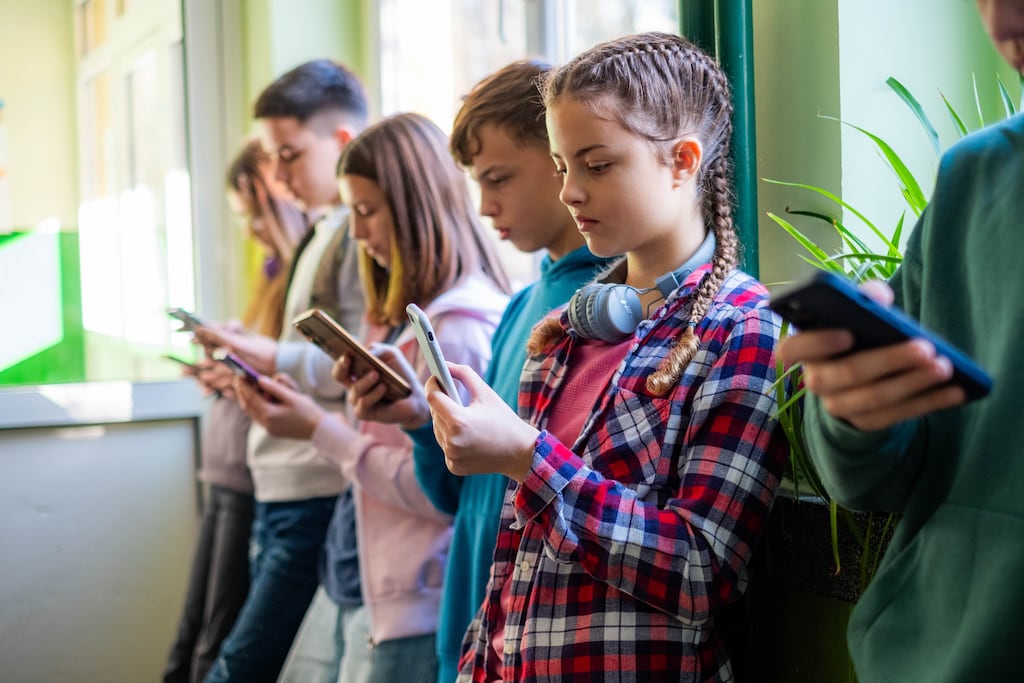

Australia’s ban on children under 16 having social media accounts is being keenly watched by parents and governments across the world.
Social media platforms have started cancelling accounts and introducing age verification; Australian under 16s have only just begun to find ways around the ban; and the first legal challenge is under way as the message board Reddit has taken a case on the basis that it restricts freedom of speech. Other platforms are no doubt watching and weighing their own responses.
What is clear is that there is widespread support for the move among Australian parents although that is matched by equal, if not greater, scepticism about whether it will be effective.
There is plenty of support for a similar initiative here and so there should be; the most recent report from charity CyberSafeKids found that 96 per cent of 15-year-olds have a smartphone and 71 per cent have TikTok, the wildly successful social platform that is caught by the Australian ban.
READ MORE


Some 51 per cent of those on TikTok said they had seen something disturbing and 43 per cent kept it to themselves. There is no world in which this is a good thing.
In a blaze of activity rather than action following the Australian ban, the Minister for Culture, Communications and Sport, Patrick O’Donovan announced plans “to bring a memo to Cabinet in the coming weeks” on the topic. He said the Government was exploring introducing a digital age of consent and age verification linked to MyGovID, the non-compulsory age verified logon used to access various government services.
It’s an ambitious project and would seem to involve a lot of work and time on the Government’s part to fix what should be someone else’s problem. The Australians just passed a law and said they would fine platforms that did not comply.
Deep links
O’Donovan’s convoluted response has, of course, to be seen in the context of our economy’s deep links to the US technology sector, and social media platforms in particular.
Facebook, TikTok, Google (the parent of YouTube) and X all have their European headquarters here and contribute millions of euro to the exchequer in taxes. They have never been more assertive and Ireland has rarely seemed less attractive as location for further inward investment by them.
There has always been a conflict between what is good for US technology companies based here and what is good for Ireland. For most of the last 30 years, the balance has been in the favour of Ireland but any move towards a ban on social media will face the same dilemma.
The Government must be hoping quietly the Australian experiment is a disaster. Failing that, they must be praying the EU takes the matter out of their hands. O’Donovan certainly seems keen to steer things in the direction of Brussels.
Ireland will, according to Donovan, make online child safety a theme of our presidency of the European Union in six months’ time. He noted that “in an ideal world”, it would be better for the European Union to act in unison on the issue but that the EU was a “gigantic organisation” that “moves slowly”.
The Europeanisation of the issue would seem to chime nicely with the views of the European Parliament, which passed a resolution in late November calling for a ban for under 16s using social media unless they have parental consent.
The European Commission might not be quite so keen on the idea. The president of the commission, Ursula von der Leyen, has kicked to touch for the time being, saying that a panel of experts will be appointed to consider the issue. She has managed to make O’Donovan look positively dynamic in the process.
Her lack of enthusiasm has to be seen in the context of the EU’s fraught relationship with the United States under Donald Trump, which took another turn for the worse last month with the publication of the latest US national security strategy. This document, which is meant to guide US foreign policy, was overtly hostile to Europe and the EU.
Opinion varies as to how seriously the document should be taken and Europe is divided as to whether it should adopt a more robust position or continue to play a longer game of appeasing Trump. In the meantime, Howard Lutnick, the US commerce secretary, has made clear that he wants the EU’s foot taken off the regulatory pedal in return for better trade relations with the US.
The European Commission is currently locked in regulatory tussles of one form or another with Amazon, Google, Microsoft and Meta and is under pressure to back off from some of these.
Its lack of enthusiasm for taking on the issue of online child protection is understandable. Von der Leyen might be happy enough to leave this one to the member states: that, of course, is the last thing Ireland wants.