Electricity prices are back in the news, with a planned major investment in the network set to lead to price increases for consumers of up to €1.75 a month for the next five years. This has generated attention for one main reason – electricity prices here are already among the highest in the EU.
One key set of figures underlines the crunch issue, which is that, after the big increase in prices following Russia’s invasion of Ukraine, there are clear signs that prices here have settled at a higher level than in other countries. And nobody is quite sure why this is the case.
This point relates to the part of consumers’ electricity bills that reflects energy costs. But consumers are being hit in two ways. They also pay so-called network, or standing, charges – which comprise up to 30 per cent of their bills – and it is these that will rise to fund the new investment plan.
Consumers may not distinguish between the two aspects, because they are all wrapped up in offers to them from energy companies, which encompass the total price. But to try to get a grip of energy bills, it is important to understand the two issues and look, separately, at what is happening in each.
READ MORE

1. Energy prices and the Irish experience
Wholesale energy prices – the cost paid by providers to get hold of the power supply they sell on to us – have swung hugely in recent years. But after all the ups and downs, Irish prices are still higher than elsewhere in Europe – or to be more precise, the gap between the wholesale prices and the element of our energy bills that reflects the cost of electricity is wider here than in other countries. A graphic in the latest International Energy Agency report tells the story.
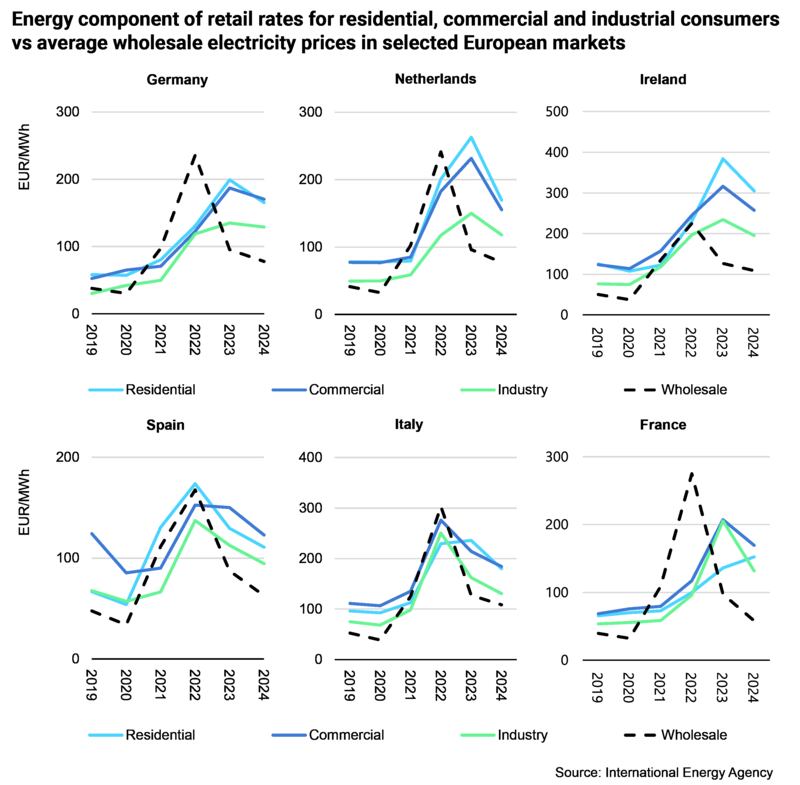
It shows how prices in different countries first responded to the sharp rise in wholesale prices after Russia invaded Ukraine and then fell back. In many countries, including Ireland, there was a lagged response. Companies had hedged their exposure by buying forward on the market and so were able to spare customers from the full impact of the surge in costs for a while. In some countries, like France, regulation limited the initial price rise.
But hedging meant that even as wholesale prices fell in 2023, retail prices in most countries were still rising to catch up. They fell through 2024 – as the graphics show – though there has been some subsequent increase.
The question for Ireland is why the energy component of the ESB bill passed on to consumers has remained so high, compared with wholesale prices. Last year residential costs before taxes and levies were roughly double what they had been in 2019. Energy credits and a lower VAT rate helped protect consumers to some extent.
Irish bills by the end of last year – again before taxes and levies – were about three times the wholesale prices, according to the IEA, compared with about twice in the five other big countries assessed. Recent Eurostat figures, which took account of energy credits paid last year, showed us at number five in the EU league for consumer prices; without those credits, Ireland is likely to be at, or close to, the top of the pile in 2025.
The answer to the “why” is more difficult. Sinn Féin, not surprisingly, has accused the electricity suppliers of “price gouging”. Less competition in the Irish market, allowing for higher prices, may indeed be one reason, but it seems unlikely to be the whole story, though we just don’t know.
In recent evidence to an Oireachtas committee, Niall Farrell and John Curtis of the Economic and Social Research Institute said the exact reason why costs were higher here “is difficult to establish, but several plausible factors exist”. These include Ireland’s limited ability to diversify away from gas-fired generation. The smaller size of the market and the dominance of gas also limit buying opportunities for suppliers. “Weaker competition in the Irish market” could also be a factor.
However, the researchers added that “limited public data constrains understanding” and may suggest a role for regulator inquiry to uncover exactly what the key factors are in the Irish market. Because, as of now, we just don’t know and that fuels consumer suspicion that prices are higher than they need to be.
2. The add-on charges
About 25 to 30 per cent of a typical electricity bill is accounted for by standing charges. These are supposed to cover the costs of your home being supplied with electricity. And regardless of how energy efficient a consumer is, they are stuck with this cost. Standing charges are set to rise to part-fund the massive investment programme being undertaken to upgrade the network by ESB Networks and EirGrid.
The extent and timing of the increases will depend on the pace of the investment programme, which is a big step up on the levels spent in recent years. The first increases are likely to kick in next October – the start of the “billing year” – and could amount to €1 per month extra, rising to as much as €1.75 if investment levels take off particularly quickly. This would be between €12 and €21 extra over the full year.
The background documents published as part of the approval process by the Commission for the Regulation of Utilities (CRU) for the investment programme show that further increases are expected – though their scale will depend on a variety of factors. Network charges for the average domestic customer are likely to rise by 15 to 20 per cent. That would mean a “baseline” increase of €59 annually by 2029/30 on current levels, or €106 under a high-investment scenario – quite apart from the actual cost of the electricity.
These charges are levied on the energy suppliers and it is then up to them how much to pass on as they market their plans to consumers.
The bottom line
The final bill for consumers will also depend, of course, on international energy prices. The Government can also influence the price through VAT – which has been cut on energy bills to 9 per cent, a rate that is due to stay in place until 2030. The PSO (public service obligation) levy that consumers also pay on their bills to help fund renewables has been trimmed from this year.
For the future, the price of gas will remain crucial. As it is the backup source of power to create electricity in Ireland, it tends to set the price. As more renewables come on stream, this may help to hold prices down – depending on the deals done to develop our wind resources – and will certainly help to provide a more reliable energy supply.
The mechanism through which prices are set in the market is likely to remain a contentious issue and may change as the share of renewables rises.
A need for a backup energy source will remain – the wind does not always blow, though energy storage technology will surely advance. But as well as improving emissions, renewables can cut Ireland’s dangerous strategic reliance on imported gas. And if gas prices were to spike, that would limit the impact.
The Government also plans to develop liquefied natural gas storage facilities, though this is likely to take some years. So, too, is the rollout of offshore wind, seen as a key source for Ireland’s energy transition but now running well behind schedule.
The problem for consumers is that the price of building out the network to allow for more renewables and a more advanced system will have to be paid up front; the pay-off may be slow enough to feed through to their bills.
More reliability will be important, of course. But while we can hope that renewables will provide a rich source of clean and cheaper energy, the promised land is still some way off. And Government universal energy credits are now, we are told, a thing of the past, even if measures to help less well-off households will remain and probably increase.
In the meantime, more clarity on why existing bills are so high in Ireland would be useful. Just because we have a high-cost economy doesn’t mean energy prices have to be at the top of the European league.
[ Irish electricity prices in two graphicsOpens in new window ]