

Arts Bubbles does not announce its line-up in advance. It does not advertise its address until after tickets are bought. There is no stage, no backstage, no raised platform from which performers might look out over an audience.
Shoes are left at the door. People sit on cushions and rugs in their socks under low lamps and neon signs, surrounded by plants and half-finished artworks. Performers stand, or move, or paint at the centre of the room, close enough that breath, hesitation and silence are part of the exchange.
For a few hours, somewhere in Dublin becomes a shared living room, where people perform, listen and connect.
Arts Bubbles’ founder, Matteo Colombo, grew up in the Italian city of Treviso, near Venice. He moved to Ireland eight years ago, but the roots of Arts Bubbles stretch across borders and cities, shaped by a life lived between cultures and ways of gathering.
READ MORE


Before settling in Dublin, Colombo lived in Copenhagen, where he encountered hygge, the Danish philosophy of intimacy, warmth and presence. “They meet in houses, with deep lights, candles, thick socks – almost like Christmas vibes, but always on,” he says. “I really got in love with this way of meeting people.”
It was there that the question first surfaced. “I was, like, what would happen if, instead of going out, we meet in homey spaces, and we bring different art forms together? Because usually arts are still very isolated. You go to a gig, or a museum, or a spoken-word night, but there’s no merging. And there’s no social aspect – you go with your friends, you go home.”
After Covid – “a big moment where we all put things in perspective and try to understand what meaning we want to give” – he decided to act. In January 2024, Colombo opened his own living room, in Dublin 8, to a group of strangers.
“We were maybe 40 people,” he says. “Very packed, very small space. We had a few music acts, a light painter, a spoken-word artist and even a comedian.” What mattered was not polish or scale but what emerged between people. “People loved it,” he says. “So we kept going.”

Arts Bubbles grew not by scaling up but by spreading sideways. Friends offered their homes. Community members suggested spaces. Themes were introduced a few events in, not as constraints but as shared points of inquiry: Alchemy of Fear, Pulse of Desires, Shapes of Love, Shifting Identities. “Big topics,” Colombo says. “Sometimes scary topics.”
The aim was never didactic. “The idea was: what if we can use the arts as ways to understand bigger things? Collective ones, individual ones. Things that belong to us as humans. We really need spaces where we gather to think about something bigger than ourselves. To forget, for a few hours, that the rest of the world exists – and then to go back into it with something new.”
What began as a living-room experiment evolved into a monthly gathering that now moves across Dublin, slipping quietly into both private and public places, always temporarily, always with care. Rather than believing that art belongs only in designated cultural venues, Arts Bubbles resists that assumption, asking what if any space could hold art, if it were treated differently?
“We don’t really pick venues based on strict criteria,” Colombo explains. “We try to envision if that location can be transformed into a space that creates intimacy and a feeling of home, wherever we go.”

Some gatherings have taken place in cafes, some in private houses; others in grand but underused institutional buildings, places many Dubliners pass daily without ever crossing the threshold.
“You step into somewhere like the Royal Irish Academy, this beautiful marble space with 300-year-old books,” he says, “and you bring performative arts into a place where usually only academia is present. People don’t even know these spaces exist.”
Line-ups and locations are kept secret until shortly before each event, a choice that not only cultivates fun and mystery but also removes expectation, dismantles hierarchy and encourages discovery of new people, new artists, new places.
In a city where cultural spaces are increasingly fragile – eroded by rising rents, redevelopment pressures and a housing crisis that makes even the idea of home precarious – this flexibility feels not only aesthetic but also essential. Dublin has lost beloved venues, rehearsal rooms, studios and informal gathering places at an alarming pace. When homes themselves are unstable, communities tied to fixed buildings struggle to survive.
“We often think that when a space shuts down, the community is broken,” Colombo says. “But that’s not true. The community is not a venue. The community is who shows up. If something doesn’t exist any more, we go somewhere else. If the people are there, we can create it.”
That urgency is felt by performers. Evan Flaherty, one-half of the folk duo The Awning, describes watching the capital’s cultural infrastructure shrink in real time. “I’ve lived in Dublin for five or six years, and I’ve just watched things coming and going,” he says. “The Workman’s Cellar closed. The Complex is shutting down. You see thousands of people signing petitions, so there’s clearly an appetite for culture, but the spaces keep disappearing.”
At the heart of Arts Bubbles is the deliberate collapse of distance – physical, social and artistic. Performers and audience sit at the same level. Artists are encouraged not only to perform but also to speak about what sits behind the work – the uncertainty, the context, the vulnerability. Painters and photographers get to explain their inspiration and process; musicians share what the theme of the night means to them; dancers not only get to involve audience members but also speak about their performance, adding words and context to their movements.
Darragh Purcell, the other half of The Awning, says that the intimate atmosphere encourages honesty, as did the theme of the night they performed: Human, Still. “Our music is very personal,” Purcell says. “It’s written from experience, about wanting to be better, about being grateful you’re here. Arts Bubbles felt like a space where that kind of vulnerability wasn’t just allowed but welcomed.”
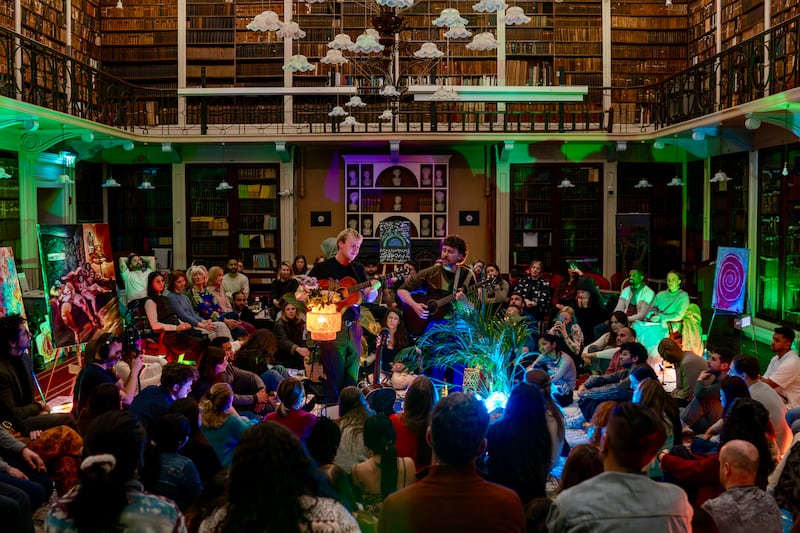
As the evening draws to a close, distinctions dissolve further. Artists come together in one collective performance, created on the night. The poet Leon Dunne describes these moments as uniquely generative. “It’s what Matteo’s partner calls the magic at the end,” he says. “You’re doing poetry and suddenly musicians are responding around you. It shouldn’t be kept in one box. Blurring the lines just makes it better.”
Boundaries and divisions also blur in beautiful ways. One recent Arts Bubble brought together people of 37 nationalities in a single room. Across all events so far, more than 60 nationalities have been represented. “For us it’s fundamental,” Colombo says. “Every person is welcome. Every art form is welcome.”
This diversity is not incidental but actively fostered. “You don’t just have different art forms giving different perspectives,” he explains. “You also have different cultural backgrounds, roots, heritages. That adds so much richness to the collective way of thinking about a theme.”
In a country grappling with rising anti-immigrant rhetoric, Arts Bubbles offers a lived alternative rather than a slogan. People meet barefoot on the same floor, experience art together, share conversation in breaks and after the event. Connection is emphasised and embodied.
“I’ve had people message me saying, ‘I’ve found a new circle of friends through Arts Bubbles’,” Colombo says. “People who never had close Irish friends are now hanging out with Irish artists. They’re getting closer to Irish culture and also discovering how much hidden talent exists in this city. The Irish community is so welcoming,” he adds. “It’s two worlds merging.”
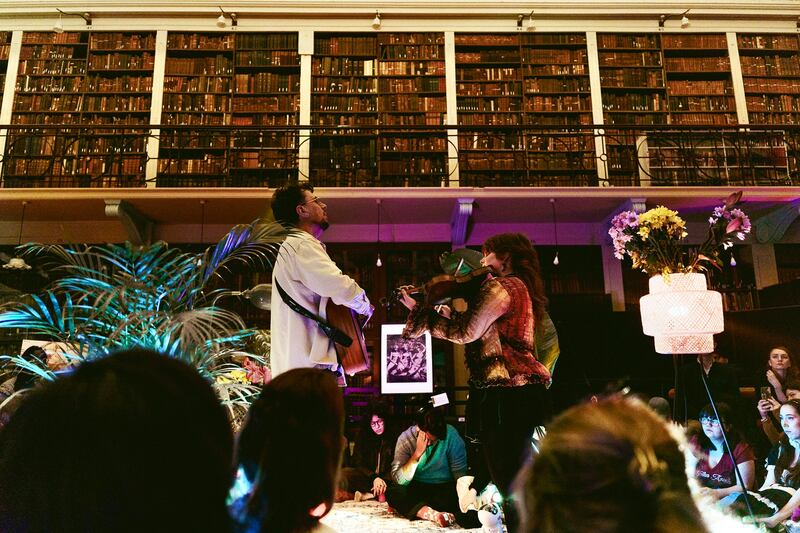
Matilde Lotti is an Italian cellist and singer who performed at the second Arts Bubble, and several since, and says that Colombo’s focus on human connection – his connection with the artists, with the audience, facilitating connection between them – is what makes Arts Bubbles unique.
“The event started to help people from different places in the world meet, so you couldn’t go with a friend: you had to go by yourself and you had to get outside your comfort zone to make friends.
“We’re in world where it’s easier to use an app to find a partner or even a friend. We’re getting way more insecure about opening up to other people, and this is a big movement against it.
“I want to see more people using the arts as a way to genuinely connect – and at Arts Bubbles it’s so friendly. There’s such a big humanity behind it.”
To Dunne, Arts Bubbles demonstrates how much creative talent and appreciation for creativity there is in Ireland. He hopes it both inspires more artistic events and inspires the audience to tap into their own creativity.
“The arts scene at the moment is bursting – but with creative spaces being taken away, we need to have more spaces, to be able to show that talent. We already have the artists. We need to have more spaces, and the community needs opportunities to come together, because every time I go to one of these shows I’m just blown away.”
What does Colombo hope someone will feel after attending their first Arts Bubble? “I think somewhere between inspired and at peace,” he says. “To do more art, to meet more people, to be vocal about what they think and what they stand for. We’d love to be a place where little revolutions for the arts and for the soul are happening every time we gather.”


