
The most complete solar eclipse most of us are ever likely to see occurs at sunset on Wednesday, August 12th.
A total eclipse of the sun will miss Ireland by only a couple of hundred kilometres, and will be completely visible in parts of Portugal and northern Spain.
However, for Ireland, it will be the next best thing, with 93 per cent coverage in the north and up to 98 per cent coverage in the extreme southwest.
These percentages are similar to the much-anticipated eclipse of August 1999, in which Dublin skywatchers got the best of the weather and the sun, obscured by the moon, turned into a bright crescent.
READ MORE


The best views of Wednesday’s eclipse will be in the southwest, where just a tiny sliver of sunlight remains mid-eclipse.
The ideal location to view would be the Blasket Islands, looking out to sea to a clear horizon where the sun is almost completely eclipsed. The more pronounced darkening of the sky will likely cause some street lights to automatically switch on, while birds will start to roost early. The brilliant planet Venus will pop into view at some stage to the far left of the sun as mid-eclipse approaches.
Multiple eclipse crescents will also be seen dappling the shaded ground beneath trees (throw down a white sheet for better contrast), or they can be projected with a colander or kitchen strainer. It’s a cool way for everyone to track the narrowing solar crescent.
By mid-eclipse the sky will appear darker than expected but light levels are still generally equivalent to a heavily overcast winter’s day, or 10-20 minutes before sunset on a clear evening. The sun’s low altitude at this time may impact what we anticipate, though.
The partial solar eclipse begins between 6.09pm in the north and a bit later the further south you go. Mid-eclipse is between 7.07pm and 7.13pm, and it ends just after 8pm across the island.
A reasonably clear western skyline will allow you to watch the proceedings as the sun starts to get low.
Changes in the ambient light level will only become apparent when the sun is nearly 80 per cent obscured. That is often experienced as an abrupt drop in brightness as our eyes compensate for changing light levels in a logarithmic way rather than linearly.
As the eclipse deepens, your surrounds can take on a strange hue, as if colour is being bled from the landscape. This transformation happens as our eyes shift from daylight/colour perception towards night/monochrome vision.
Several astronomy clubs and facilities countrywide have co-ordinated eclipse viewing events with the details listed on their respective websites.
These include Armagh Observatory, Ballycroy Visitor Centre in Mayo, Birr Castle Demesne, Blackrock Castle Observatory in Cork, Dunsink Observatory in Dublin, NUI Maynooth’s department of physics, the Irish Astronomical Society (at the Phoenix Park Visitor Centre), the Irish Astronomical Association in Belfast and Midlands Astronomy Club.
Irish and Italian research teams plan to intercept the eclipse track off Ireland’s coast from on board an Air Corps aircraft. Detailed photographs of the region of the inner corona during totality will show changes on a very short timescale and add to our understanding of the heat transfer mechanism.
Circumstances are not as good again for us until a total solar eclipse on September 23rd, 2090, which again favours the southwest. Total solar eclipses in Ireland are incredibly rare; the last one was on May 22nd, 1724.
This year’s eclipse is total on a narrow track that initially favours some countries ringing the Arctic before the moon’s umbra passes about 220km off our coast. The path next makes landfall in Spain diagonally from the north to roughly southeast and ends by treating the Balearic Islands to a spectacular totality just minutes before sunset.
If winning the World Cup was not enough, Spain will enjoy two total eclipses in as many years, with another one due next year on August 2nd, 2027, which will be the longest one for more than a century. In 2028, Spain will also have an annular eclipse when the moon will obscure all but the outer disk of the sun, making it look like a ring of fire.
How to keep your eyes safe
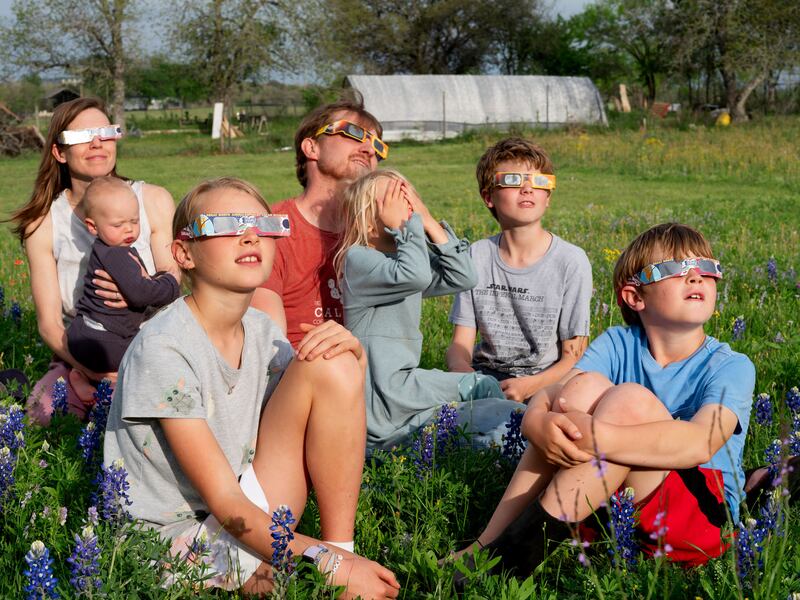
While there will be a lot of interest in this partial eclipse, eye safety is paramount should you plan to take a look, as the fraction of sun remaining mid-eclipse is still unsafe to stare at directly without taking proper care.
However, practical and safe ways to watch the show unfold are described in a booklet at eclipse26.ie, compiled by Dunsink Observatory and ESERO Ireland.
Certified eclipse glasses have filters made with special material to reject the sun’s dangerous energy across various wavelengths, but check for any pinholes first by holding them up to a light, and discard if you notice any scratches.
Polarised sunglasses, aluminium foil, or similarly opaque items, on the other hand, do not offer the same protection, nor dim the sun sufficiently, and should not be used.
Without taking proper precautions, there is a risk of permanent eye injury due to thermal retinal burn. Your eye’s retina has no pain receptors, so you are unaware as the harm is being done.
One way to demonstrate that is to hold your hands at right angles to each other: the shadows cast that lie at right angles to the orientation of the sun’s crescent remain blurry, whereas those aligned with the sun’s narrowing crescent are sharper.
John Flannery is editor of the Irish Astronomical Society’s quarterly journal


